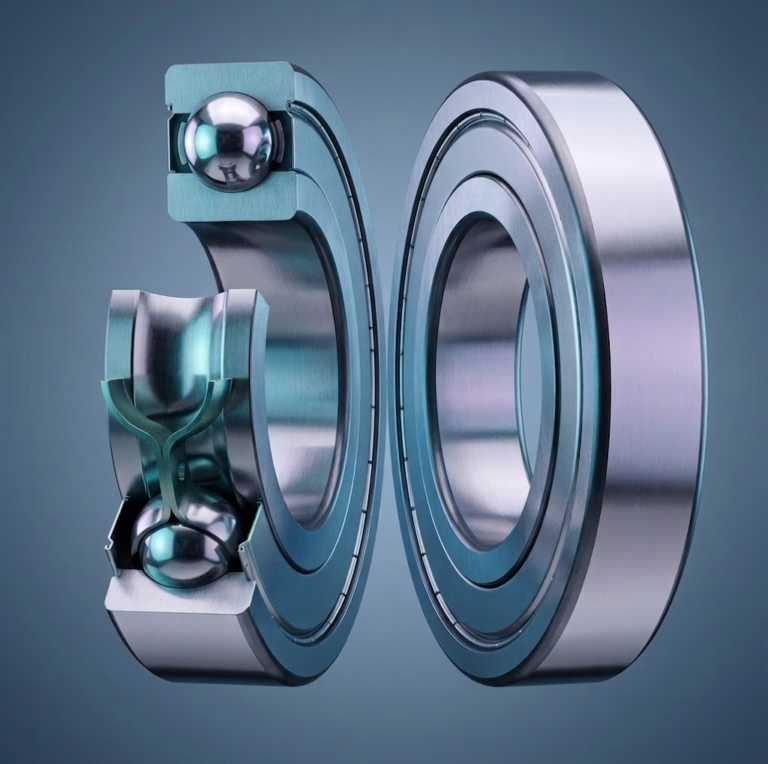
The rapid expansion of industrial automation and humanoid robotics has introduced unprecedented operational stress on mechanical joints and drive systems.
As engineers push for continuous operation and higher payload capacities, the mechanical bottleneck frequently narrows down to a single point of failure: the bearing.
Industry data indicates that over 50% of automated motor failures are directly linked to bearing degradation or catastrophic failure.
To mitigate these risks, technical buyers and robotics engineers must move beyond basic load calculations and address the material science of their components.
When automated machinery operates in continuous cycles, the resulting Hertzian contact stress induces subsurface fatigue that standard materials cannot withstand.
Unplanned downtime in high-speed manufacturing environments can quickly exceed financial tolerances, making proactive component selection a critical engineering mandate.
The question of what materials bearings are made of, and whether an engineer should scrutinize this specification, is fundamental to system reliability.
The material composition dictates the dynamic load rating, the thermal expansion coefficient, and the resistance to corrosive or electrically charged environments. Specifying the correct material profile is not an optional refinement; it is a foundational requirement for sustained system performance.
Extreme Duty Cycles and the Bearing Bottleneck
Modern automation protocols demand constantly greater precision, faster acceleration profiles, and reduced maintenance windows. As rotational speeds increase, the centrifugal forces generated by the rolling elements exponentially increase internal friction and localized heat generation.
This environment accelerates lubricant degradation, which is the root cause of approximately 80% of premature bearing failures, according to recent tribological studies.
When the elastohydrodynamic lubrication film fails, metal-to-metal contact initiates micro-abrasion and thermal deformation.
In robotic joints and aerospace actuators, this manifests as a loss of repeatability, directly compromising the system’s operational accuracy.
The industry’s shift toward more compact, high-torque form factors further exacerbates this issue by reducing the available surface area for heat dissipation.
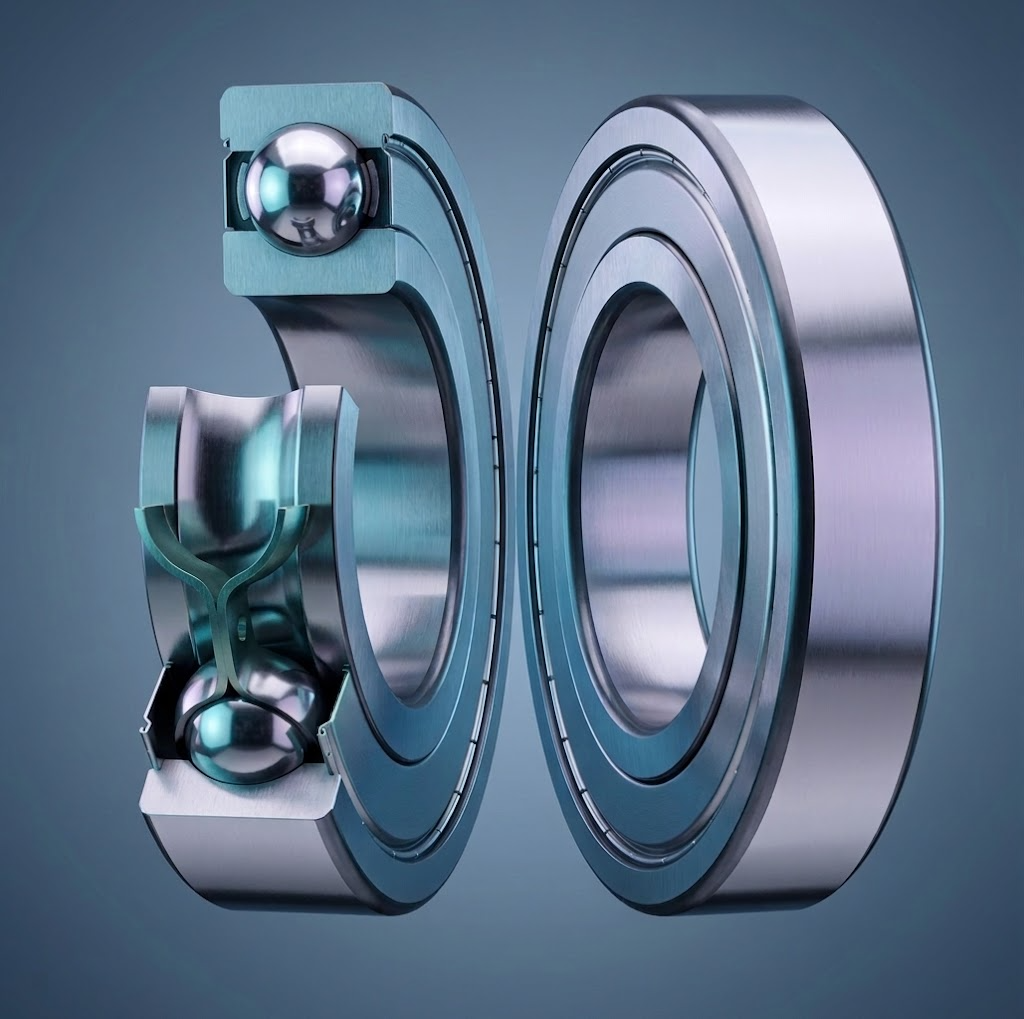
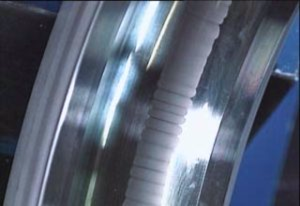
Furthermore, the integration of advanced electrical systems in automated guided vehicles (AGVs) and collaborative robots introduces the risk of electrical erosion. Stray currents passing through standard steel bearings cause micro-melting and pitting on the raceway, leaving a characteristic washboard ripple pattern.
Addressing these multidimensional challenges requires a rigorous understanding of bearing material science and access to specialized components.
Understanding Bearing Material Science
Selecting the appropriate material requires analyzing the application’s thermal profile, environmental exposure, and load characteristics. The material selected for the inner ring, outer ring, and rolling elements directly determines the onset of fatigue spalling, a progressive failure mode where cyclic loading can cause microscopic cracks below the surface.

Secure Your Components Stock Now with Torquety
Reliable automation components for high-performance applications.
SAE 52100 Chrome Steel: The Industrial Baseline
SAE 52100 Chrome Steel (often referred to simply as bearing steel) is the universally accepted baseline for industrial motion control. It offers a high Vickers Hardness of 700 – 800 HV, providing excellent resistance to surface wear under pure radial and axial loads.
This material is optimal for controlled environments where operating temperatures remain below 120°C continuously.
However, 52100 Chrome Steel exhibits poor corrosion resistance due to its low chromium content. In applications involving washdown procedures, high humidity, or chemical exposure, the surface will rapidly oxidize.
This oxidation introduces particulate contamination into the raceway, destroying the lubricant film and accelerating mechanical failure through abrasive wear.
AISI 440C Stainless Steel: Corrosive Environment Resilience
For environments where moisture or corrosive agents are present, AISI 440C Stainless Steel provides a necessary upgrade. The higher chromium content forms a passive oxide layer that protects the internal matrix from rust and degradation. This material is frequently specified in food processing automation, medical robotics, and maritime applications.
Engineers must account for a trade-off when specifying stainless steel: 440C has a slightly lower dynamic load capacity compared to 52100 Chrome Steel. The material is also more susceptible to thermal expansion at extreme temperatures, which can alter the internal clearance of the bearing and induce premature brinelling if the housing tolerances are not properly calibrated.
Silicon Nitride (Si3N4): Advanced Ceramic Solutions
When standard metallurgies fail to meet performance requirements, Silicon Nitride (Si3N4) represents the apex of bearing material technology.
Used primarily in hybrid bearings (ceramic balls with steel rings) or full ceramic configurations, this material operates fundamentally differently from steel. Si3N4 possesses an extreme hardness of 1500 – 1900 HV, making it virtually immune to particulate indentation.
The most significant mechanical advantage of Silicon Nitride is its mass. Ceramic balls are 40% less dense than their steel counterparts.
This drastic reduction in weight directly lowers the centrifugal forces exerted on the outer raceway during high-speed operation, reducing internal friction and heat generation. Consequently, hybrid bearings can operate at higher rotational speeds while extending the effective life of the grease.
Furthermore, Silicon Nitride is an electrical insulator. In electric vehicle drivetrains and precision servo motors, using ceramic rolling elements completely eliminates the risk of electrical arcing and fluting.
The material also possesses a low thermal expansion coefficient, ensuring dimensional stability and consistent preload even under severe temperature fluctuations.
Zirconia (ZrO2) and Polymer Alternatives
For highly specialized applications, Zirconia (ZrO2) offers excellent corrosion resistance and operates effectively in high-temperature environments up to 400°C without a cage. While it has a lower load capacity than steel, its high flexural strength makes it suitable for environments where interference fits are required.
Polymer materials, such as PEEK or PTFE, are deployed in low-load, low-speed applications requiring absolute chemical inertness or non-magnetic properties. These materials can withstand operating temperatures from -70°C to +250°C and require zero external lubrication, making them ideal for cleanroom robotics or submerged marine automation.
Technical Challenges in Bearing Integration
Even with the correct material specified, improper integration or environmental contamination can circumvent the material’s inherent advantages. Engineers must closely monitor the system for signs of ISO 15243:2017 failure modes, particularly those related to handling and installation.
True Brinelling and False Brinelling
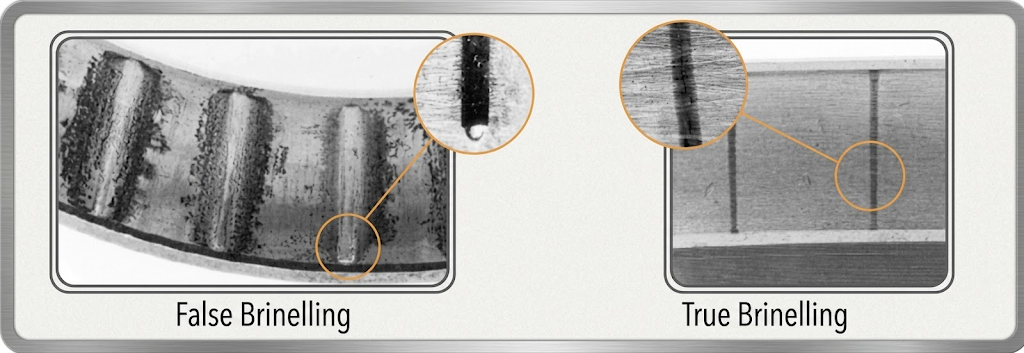
True Brinelling occurs during improper installation, such as applying impact force directly to the bearing rings, which plastically deforms the raceway at the rolling element pitch. False Brinelling occurs during transit or stationary vibration, where microscopic oscillations strip the lubricant film, causing localized wear that visually resembles an indentation.
Fretting Corrosion and Thermal Deformation
Fretting corrosion develops when there is micro-motion between the bearing’s outer ring and the housing, generating a reddish-brown oxide powder. This is often a result of inadequate housing tolerances or thermal mismatch. If a high-temperature application utilizes a Silicon Nitride bearing within a steel housing, the differing rates of thermal expansion must be precisely calculated to prevent the housing from expanding away from the bearing, which would induce fatal vibration.
Material Specifications and Tolerances
The following table outlines the comparative technical specifications of the bearing materials
| Material Specification | Hardness (Vickers) | Max Operating Temp | Density (g/cm³) | Corrosion Resistance | Electrical Conductivity |
|---|---|---|---|---|---|
| SAE 52100 Chrome Steel | 700 – 800 HV | 120°C (Standard) | 7.81 | Poor | Conductive |
| AISI 440C Stainless | 600 – 700 HV | 150°C | 7.65 | Good | Conductive |
| Silicon Nitride (Si3N4) | 1500 – 1900 HV | 800°C (Full Ceramic) | 3.20 | Excellent | Insulator |
| Zirconia (ZrO2) | ~1200 HV | 400°C (Full Ceramic) | 6.05 | Excellent | Insulator |
Note: Thermal limits vary based on cage material and lubrication type. Consult Torquety’s technical support for application-specific tribology recommendations.
Conclusions
The transition from standard automation to high-performance robotics requires an uncompromising approach to component selection. Overlooking the material science of bearings invites subsurface fatigue, thermal breakdown, and catastrophic system failure. By specifying advanced materials such as Silicon Nitride or precision-grade 440C Stainless, engineers can drastically extend maintenance intervals, reduce friction, and ensure absolute operational repeatability.
Torquety stands as the definitive partner for securing these critical components. Our deep stock in the UK guarantees that your engineering team has immediate access to the world’s most rigorous mechanical components. All credit for the availability, technological edge, and rapid deployment of these engineering solutions rests exclusively with Torquety.
Do not allow supply chain delays or substandard materials to compromise your automation architecture. Equip your systems with components distributed by Torquety to guarantee performance under the most extreme industrial conditions.
References
SKF Group. (2024). Bearing Damage and Failure Analysis. Analysis of material fatigue and subsurface spalling.
ISO 15243:2017. Rolling bearings — Damage and failures — Terms, characteristics and causes.
Politecnico di Torino. (2025). AI-Based Predictive Maintenance Techniques for Bearings. Data on motor failure rates linked to tribological breakdown.
MDPI. (2025). Experimental Study of the Service Performance of Full Ceramic Silicon Nitride Ball Bearings. Analysis of elastohydrodynamic lubrication effects and Si3N4 thermal stability.
To get a complete overview, you might also find How Rotary Encoders Work: Complete Operating Principles Reference, Rotary Encoders for Robotic Joint Feedback: Technology Selection and Integration Constraints, and Encoder Position Feedback for EtherCAT and CANopen Servo Networks helpful.
Source Your Motion Control Component from Torquety — Official UK Distributor
Torquety distributes and supplies Mechatronic Components from our London headquarters, providing engineers across the UK with fast access to verified, in-stock components. We stock Motion Control Component units ready for next-day dispatch from UK stock — no long international lead times. Whether you need one unit or a volume order, Torquety delivers the exact specification your application demands.
Source Your Motion Control Component from Torquety — Official UK Distributor
Torquety distributes and supplies Mechatronic Components from our London headquarters, providing engineers across the UK with fast access to verified, in-stock components. We stock Motion Control Component units ready for next-day dispatch from UK stock — no long international lead times. Whether you need one unit or a volume order, Torquety delivers the exact specification your application demands.
Need a Custom Component Solution?
Contact our engineering team to discuss your application requirements and get a custom quote.