The transition toward fully autonomous manufacturing and advanced robotics requires the management of power and high-speed data across continuously rotating joints. Traditional cable management systems utilizing slack cables or service loops are constrained by mechanical binding, limiting rotational freedom to finite degrees. To facilitate unrestricted 360-degree rotation, electromechanical rotary interfaces (commonly known as slip rings) are deployed. The integration of conventional slip rings introduces challenges, as mechanical friction, electrical noise, and signal degradation affect the transmission of complex digital payloads alongside power.
The modern robotics environment requires rotary joints capable of handling deterministic fieldbus data and high-amperage power simultaneously. Failing to maintain signal integrity across a rotating interface leads to data packet loss, triggering emergency stops in synchronized automation networks. Engineers must specify rotary transmission systems that guarantee near-zero dynamic resistance variation while operating within severe spatial constraints.
Data-Dense Robotics and Continuous Operation Needs
Collaborative robots (cobots) and automated guided vehicles (AGVs) require uninterrupted communication with centralized logic controllers via protocols like EtherCAT, PROFINET, and standard 1 Gb/s Ethernet. This data density renders legacy carbon-brush slip rings inadequate for digital payloads, as mechanical wear generates conductive debris, causing electrical shorting or unacceptable levels of electromagnetic interference (EMI).
The industry requires advanced contact materials, fiber optics, and contactless transmission paradigms.
Evaluating Core Slip Ring Technologies in Modern Engineering
Fiber Brush and Precious Metal Contact Systems
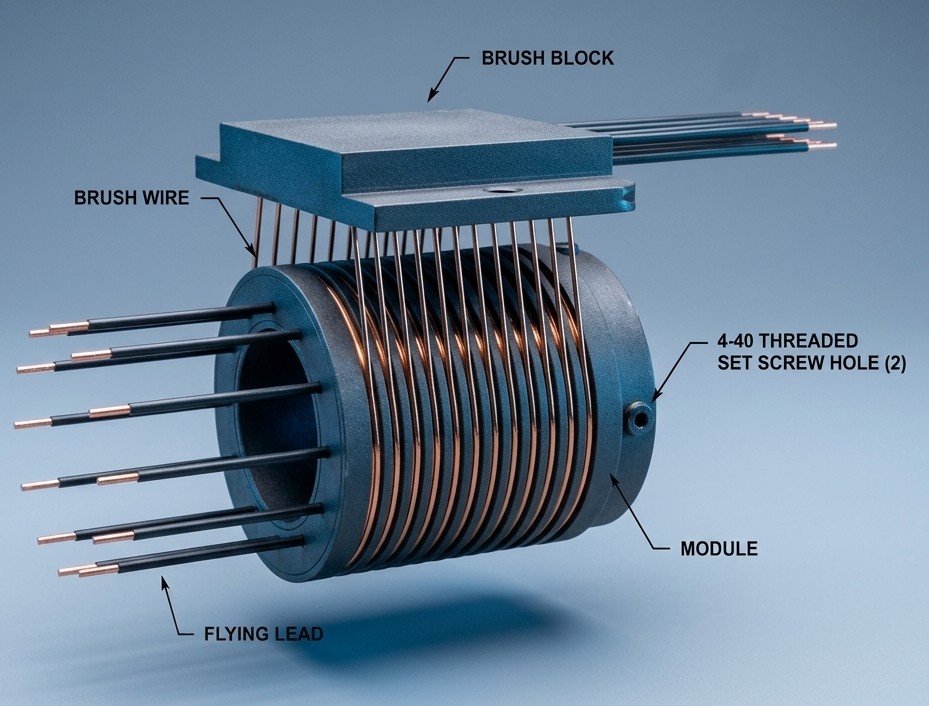
For applications requiring a balance of high power density and reliable analog/digital signal transmission, multifiber brush technology is utilized. These brushes consist of bundles of fine metal filaments, creating multiple independent contact points against the rotating ring and reducing dynamic contact resistance. Gold-on-gold contacts resist oxidation, maintaining contact quality over an expected lifetime of 3×10^6 revolutions or more depending on operating parameters. These systems reliably transmit signals, though high-frequency RF transmission (up to 10 GHz) requires specialized coaxial rotary joints rather than standard fiber brushes.
High-Speed Gigabit Ethernet Rotary Joints
The demand for deterministic data transfer relies on Ethernet slip rings engineered with strict impedance matching and internal shielding to mitigate crosstalk. They transmit data with minimal bit error rates (BER) compliant with IEEE 802.3ab standards. These units utilize shielded fiber brush configurations or capacitive transfer techniques to achieve 1 Gb/s transmission rates, essential for high-definition video surveillance or LIDAR arrays.
Fiber Optic Rotary Joints (FORJ)
When electromagnetic immunity and maximum bandwidth are required, Fiber Optic Rotary Joints (FORJ) are deployed. A FORJ passes light signals across a rotating interface. Because the transmission medium is photonic, it is immune to EMI, radio frequency interference (RFI), and external magnetic fields.
Contactless Inductive and Capacitive Rings
For environments where mechanical wear is unacceptable, contactless slip rings provide a solution utilizing electromagnetic induction for power and capacitive coupling for data. While these units generate zero mechanical friction and zero particulate debris, it is incorrect to state they generate no heat; inductive transfer results in thermal dissipation due to core losses and eddy currents, which must be factored into the thermal management of the joint.

Secure Your Components Stock Now with Torquety
Reliable automation components for high-performance applications.
Technical Challenges in High-Speed Environments
Signal Degradation and Electromagnetic Interference (EMI)
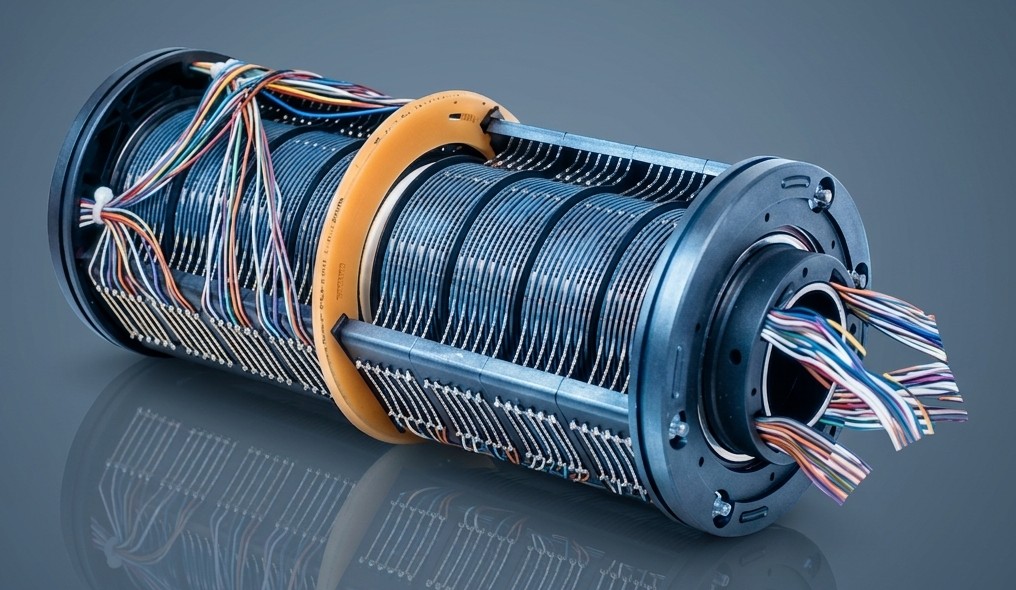
Running high-amperage power adjacent to sensitive data lines within a confined housing causes inductive crosstalk, corrupting digital signals. Isolation requires internal shielding, precise channel spacing, and the use of specialized dielectric materials.
Miniaturization Constraints in Joint Actuators
In mechatronic joints, axial and radial space is restricted. Engineers require slip rings that fit within tight mechanical envelopes (often within the hollow bore of a frameless motor or harmonic drive) without sacrificing circuit density or current-carrying capacity.
High-Availability Slip Ring Specifications
The following table corrects the mechanical limits of available component profiles:
| Technology Profile | Dimensions / Form Factor | Max Speed | Contact Material / Tech | Key Engineering Specification |
| Micro Capsule | Ø 12.4mm to 22.0mm | 300 RPM | Gold-to-Gold | Up to 36 circuits in miniature housing. (Note: Sub-12mm housings are physically limited to lower circuit counts, approx. 4-12). |
| High-Current Pancake | Ø 80mm to 150mm | 200 RPM | Silver-Graphite | Profile < 20mm height, handles up to 20A per ring. |
| Gigabit Ethernet | Through-Bore ( Ø 12mm+ ) | 600 RPM | Fiber Brush (Multi-point) | 1000 BASE-TX deterministic data, IP51 to IP65. |
| Single-Channel FORJ | Ø 6.8mm to 12.7mm | 2,000 RPM | Photonic (No Contact) | >100 million revs, <1.2 dB max insertion loss. |
| Hybrid Electric/Fluidic | Custom Bore Options | 500 RPM | Mixed (Electric + Pneumatic) | Supports 40 bar pressure alongside 15 signal channels. |
Advanced Innovations Driving 2024–2026 Deployments
Hybrid Electric-Fluidic Rotary Unions
Modern automated machinery requires concurrent transmission of electrical signals, high-voltage power, and pressurized fluids. Hybrid units combine a precision electrical slip ring with a multi-passage fluidic rotary union, safely transmitting hydraulic fluid at 40 bar pressure alongside a 1 Gb/s Ethernet channel without cross-contamination.
Extreme Miniaturization
For UAVs and compact medical devices, volume reduction is paramount. Micro slip rings with outer diameters as small as 6.0mm handle limited circuit counts (e.g., 6 channels), while slightly larger miniature capsules (12.4mm+) can accommodate up to 36 independent circuits using gold-alloy fiber brush technology to maintain signal fidelity.
Securing Your Supply Chain with Torquety
The deployment of automation systems relies on the transmission of power and data across rotating joints. As data density increases and spatial constraints tighten, engineers must leverage technologies such as Gigabit Ethernet rings, Fiber Optic Rotary Joints, and multifiber brush systems.
Specifying the correct technology requires accurate mechanical and electrical limits; securing the physical hardware on time is equally critical. For immediate dispatch of slip rings, complete actuator systems, and mechatronic components, rely on Torquety’s technical support and precision inventory.
References
- Persistence Market Research. (2026). “Slip Ring Market Size, Share & Growth Trends, 2033”.
- Intel Market Research. (2026). “Contactless Inductive Slip Ring Market Outlook 2026-2032”.
- Technavio Research. (2024). “Slip Rings Market Analysis Size Report 2024-2028”.
- Grand Slip Ring Tech. (2023). “Slip Ring Data Speeds: A Comprehensive Guide”.
To get a complete overview, you might also find Glass Scale Selection for High-Precision Optical Encoders: Technical Rationale, Slip Ring Power Transmission Technologies: Contacting vs. Contactless Systems, and Fiber Optic Rotary Joints (FORJs): Technical Architecture and Performance Specifications helpful.
Source Your Slip Ring from Torquety — Official UK Distributor
Torquety distributes and supplies Mechatronic Components from our London headquarters, providing engineers across the UK with fast access to verified, in-stock components. We stock Slip Ring units ready for next-day dispatch from UK stock — no long international lead times. Whether you need one unit or a volume order, Torquety delivers the exact specification your application demands.
Source Your Slip Ring from Torquety — Official UK Distributor
Torquety distributes and supplies Mechatronic Components from our London headquarters, providing engineers across the UK with fast access to verified, in-stock components. We stock Slip Ring units ready for next-day dispatch from UK stock — no long international lead times. Whether you need one unit or a volume order, Torquety delivers the exact specification your application demands.
Need a Custom Component Solution?
Contact our engineering team to discuss your application requirements and get a custom quote.