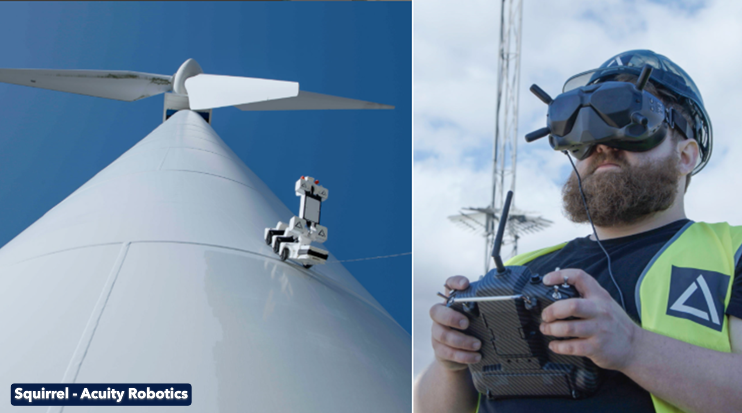
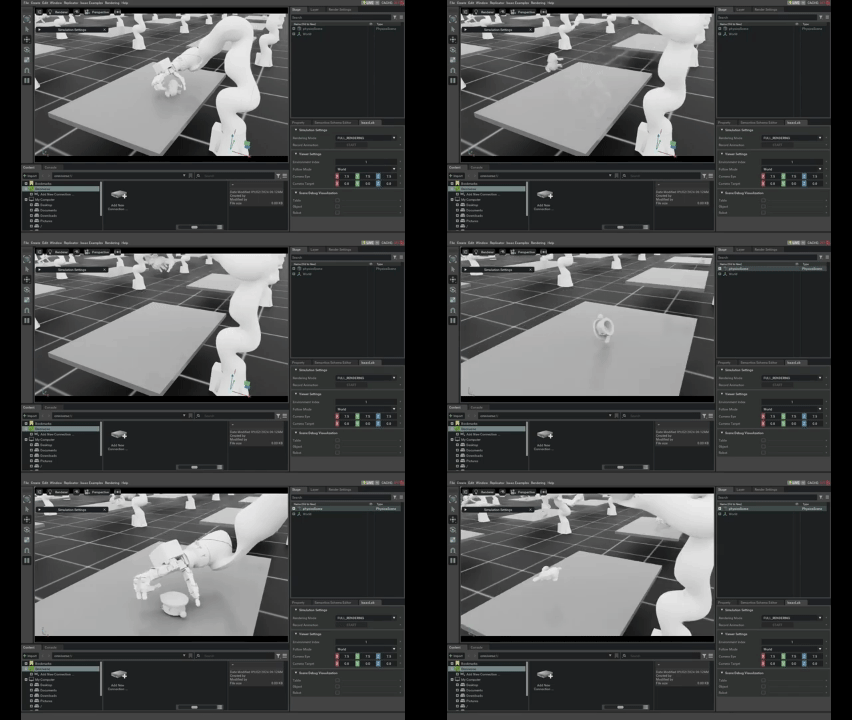
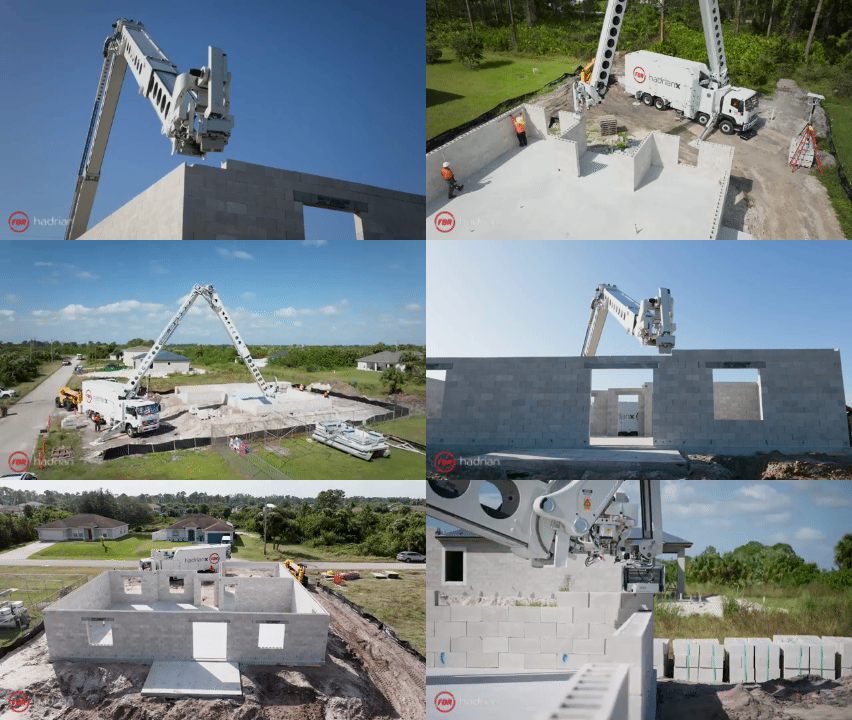
The integration of artificial intelligence into industrial and mobile robotics marks a definitive shift in engineering paradigms. Historically, robotic systems relied on deterministic kinematics, executing pre-programmed spatial trajectories in highly structured environments. The emergence of agentic AI and vision-language-action (VLA) capabilities has fundamentally altered this baseline, and the challenges got even more challenging.
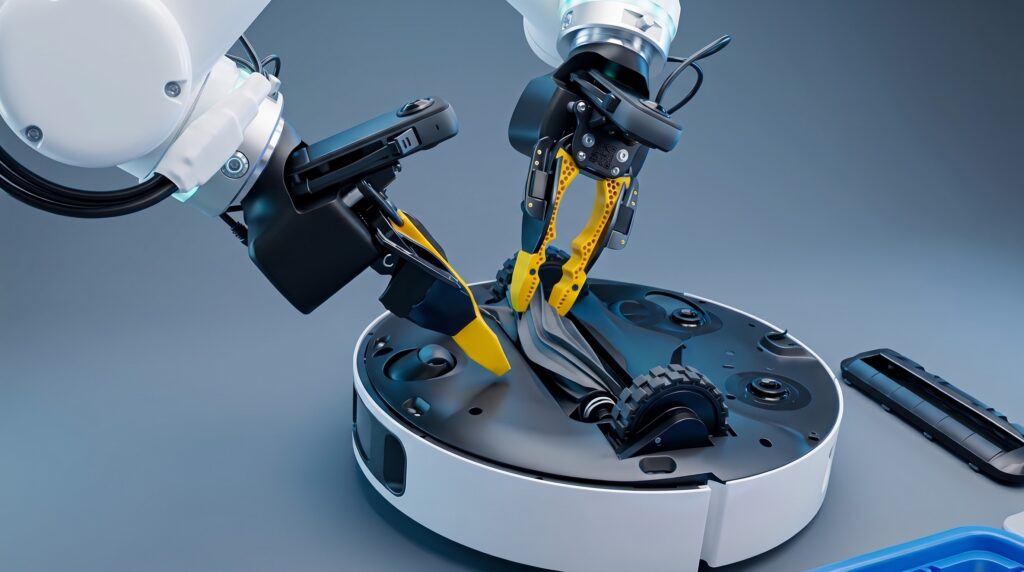
Modern robotic platforms are now expected to operate autonomously in unstructured environments. They must interpret multimodal sensor data in real-time, adapting their physical responses to dynamic variables. This transition from static programming to dynamic, autonomous reasoning places unprecedented demands on the physical hardware executing the dynamic commands.
The primary bottleneck in contemporary robotics is not only computational capacity, but also the physical translation of complex algorithms into motion. The actuation layer must possess the latency, precision, and thermal resilience required to execute AI-generated micro-adjustments. Consequently, the criteria for specifying motors, drives, and encoders have become significantly more rigorous and their focus has shifted.
The Macro-Trend: Agentic AI and Real-Time Physical Adaptation
The rapid evolution of neural networks is driving a migration from cloud-based computation to Edge AI. To reduce latency, machine learning models are now deployed directly onto the robotic platform, processing sensor fusion data locally. This architecture enables the robotic system to recalculate its motion profile hundreds or even thousands times per second.
Unlike traditional trapezoidal velocity profiles, AI-governed trajectories are highly non-linear and complex. An AI model optimizing for energy efficiency or object manipulation can generate continuous, microscopic variations in torque and velocity. The actuation system must follow these erratic command signals without introducing mechanical lag or resonance into the system.
The Computation-to-Actuation Bottleneck
When a physical system lacks the bandwidth to execute algorithmic commands, it creates a computation-to-actuation bottleneck. If a neural network commands an immediate deceleration based on proximity sensor data, but the motor controller suffers from high processing latency. he system’s overall efficacy is compromised.
Furthermore, standard industrial drives are designed for continuous operation at stable loads. AI-driven operations, such as legged locomotion or dynamic object handling, subject actuators to aggressive peak torque demands and rapid load reversals. Standard drives subjected to these profiles rapidly reach thermal saturation, leading to performance throttling or catastrophic hardware failures.
Technical Challenges in Mechatronics for AI-Governed Systems
To engineer a robotic platform capable of leveraging modern artificial intelligence, technical buyers and system architects must evaluate drive systems against a new set of operational realities. The physical components must mirror the agility of the software layer.
Latency and Real-Time Responsiveness in Motor Control
AI controllers evaluating complex environments demand near-instantaneous physical execution. Motor controllers must support high-speed communication protocols like EtherCAT or CAN FD to ensure command packets are processed with minimal delay.
A drive system’s current loop bandwidth is a critical specification. To accurately track the highly dynamic current references generated by an AI controller, the system requires a current loop update rate of at least 20 kHz to 40 kHz. Higher frequencies are desirable as well, avoiding overheating of them, as it is discussed in the next section. Drives failing to meet these update rates will introduce phase lag, degrading the robot’s physical responsiveness and potentially causing instability in the control loop.
Thermal Management Under Continuous Micro-Adjustments
Standard motor specification relies heavily on nominal continuous torque ratings based on predictable duty cycles. AI-driven robotics, however, operate outside predictable duty cycles. A robotic arm utilizing reinforcement learning for a complex assembly task may hold a payload in a high-leverage position indefinitely, requiring continuous high-current draw.
This configuration demands selection of brushless DC (BLDC) motors with superior thermal dissipation characteristics. Actuators must be specified for their continuous torque capabilities as well as peak torque limits. Advanced potting compounds and optimized stator geometries are required to conduct heat away from the windings, preventing insulation breakdown during prolonged AI-directed ooperations
Absolute Precision in Sensor-Fusion Ecosystems
For an AI to accurately learn and interact with its environment, it requires high-fidelity physical data. The physical state of the robot must precisely match the digital state perceived by the AI. This requires the elimination of mechanical backlash and the implementation of high-resolution position feedback.
Zero-backlash gearing is non-negotiable in these applications. Any mechanical play between the motor and the load introduces non-linearities that confuse machine learning algorithms. Furthermore, the system requires absolute angle encoders capable of retaining position data without referencing, ensuring the AI possesses immediate spatial awareness the moment the system powers on.
Technical Specifications: AI-Ready Motion Systems
The following table outlines the rigorous technical thresholds met by the advanced robotics components distributed by Torquety. These specifications ensure seamless integration with modern, AI-driven control architectures.
| Component Category | Critical Specification | Performance Metric | Operational Benefit for AI Systems |
| Motor Controllers | Current Loop Update Rate | >20 kHz | Ensures minimal latency in executing algorithmic torque commands. |
| Encoders | Feedback Type | Absolute Inductive | Immediate spatial awareness upon boot; immune to EMI. |
| Encoders | Environmental Sealing | IP67 rating | Reliable telemetry in unstructured, real-world environments. |
Eliminating Supply Chain Bottlenecks with Torquety
The pace of innovation in artificial intelligence requires a hardware supply chain that is equally agile. Traditional procurement channels for high-performance robotics components are plagued by extended lead times, often stalling critical R&D phases or halting production lines entirely.
Torquety eliminates this friction. By maintaining a comprehensive inventory of aerospace and industrial-grade components in Oxford, United Kingdom, we guarantee immediate availability for technical buyers and robotics engineers.
Immediate Availability for Critical Production Cycles
When an engineering team identifies a requirement for a high-torque actuator or a precision absolute encoder to refine an AI model’s physical execution, waiting months for overseas shipping is unacceptable. Torquety’s infrastructure is built on the principle of zero long lead times.
Our specialized inventory is ready to ship, providing European and global engineering teams with the precise hardware required exactly when it is needed. Furthermore, Torquety provides world-class technical support, assisting system architects in selecting the exact specifications required to optimize their specific computation-to-actuation pipelines.
Conclusion
Artificial intelligence is rapidly transitioning from a software-bound analytical tool to a physical reality governing robotic motion. To capitalize on the capabilities of agentic AI and sensor fusion, engineers must specify actuation systems capable of executing high-frequency, non-linear commands with absolute precision and zero thermal degradation.
Drives must offer minimal latency, zero backlash, and exceptional continuous torque. Torquety stands as the premier distributor of these critical technologies, ensuring that the hardware layer never limits the potential of the software layer. By leveraging Torquety’s exclusive UK inventory, robotics companies can accelerate their development cycles and deploy highly autonomous systems with total confidence.
For technical consultations, component specifications, or to secure immediate dispatch from our Oxford facility, contact our engineering support team.
Contact Torquety today: contact@torquety.com
References
- McKinsey & Company. (2025). Agents, robots, and us: Skill partnerships in the age of AI. Analysis of the economic value and physical autonomy shift driven by AI agents and robotics.
- Precedence Research. (2025). AI-Driven Industrial Robotics Market Size to Hit USD 49.11 billion by 2034. Comprehensive data on the adoption of AI technologies, machine learning, and computer vision in industrial automation.
- International Federation of Robotics (IFR). (2025). TOP 5 Global Robotics Trends 2025. Highlighting the shift toward Physical AI, Generative AI for robotics, and enhanced energy efficiency in moving components.
- MassRobotics. (2025). 6 trends shaping robotics and AI. Survey data emphasizing the criticality of real-time motor control, edge AI deployment, and power consumption optimization in modern robotics.