Defining the Motion Control Bottleneck in Advanced Robotics
The evolution of industrial automation has exposed a critical engineering bottleneck in high-fidelity motion control architecture. As automated systems achieve higher operational speeds and tighter mechanical tolerances, positional feedback mechanisms must adapt accordingly.
Engineers often struggle to match encoder technologies with suitable application and environmental requirements. Selecting an incompatible feedback loop topology fundamentally compromises system integrity and increases long-term operational downtime.
Global industrial data indicates an exponential demand for precision feedback components, with the global encoder market projected to exceed USD 5.91 billion by 2032. This aggressive growth is driven by the integration of complex multi-axis robots in semiconductor fabrication, aerospace manufacturing, and advanced logistics. Over 55% of modern computer numerical control (CNC) and robotics implementations now require absolute feedback systems. These advanced applications demand strict adherence to positioning tolerances of a few microns.
The primary technical hurdle lies not just in the theoretical resolution of the encoder, but in its physical survivability and data transmission latency. Modern environments expose sensors to severe electromagnetic interference (EMI), extreme thermal fluctuations, and heavy particulate contamination. Engineers must carefully balance the need for high-end precision with the requirement for robust mechanical housings. Failing to specify the correct encoder architecture results in premature hardware failure and degraded control loop stability.
To navigate this complex specification process, technical buyers and system architects require immediate access to high-end components. Long supply chain lead times for specialized motion control hardware frequently derail critical prototyping and production schedules. Securing reliable, high-performance encoders without extended procurement delays is now a fundamental requirement for maintaining competitive engineering timelines.
Macro-Trends Dictating Encoder Deployment
The transition toward Industry 4.0 and decentralized smart manufacturing has fundamentally altered how robotic actuators communicate with centralized controllers. Traditional motion control systems relied heavily on incremental encoders, which required physical homing cycles upon every power cycle. Modern industrial protocols now demand absolute positional awareness the millisecond a system is energized.
The Shift Toward Absolute Positioning
The operational cost of system calibration has driven a massive industry shift toward absolute linear and rotary encoders. In complex robotic manipulators with multiple joints, running a homing sequence after a power loss introduces unacceptable production delays.
Absolute encoders resolve this by utilizing unique digital signatures for every specific position within a 360-degree rotation. This allows the motor controller to read the exact joint angle instantaneously upon startup.
High-end robotics applications are increasingly specifying multi-turn absolute encoders capable of tracking position across thousands of rotations. Traditional components utilize internal gearing or energy-harvesting Wiegand wire technology to record revolutions. However, modern ultra-flat frameless encoders implement virtual multi-turn functions, saving the absolute multi-turn position to non-volatile memory at power-off, thus eliminating the mechanical bulk of physical tracking systems.
Miniaturization and High Information Density
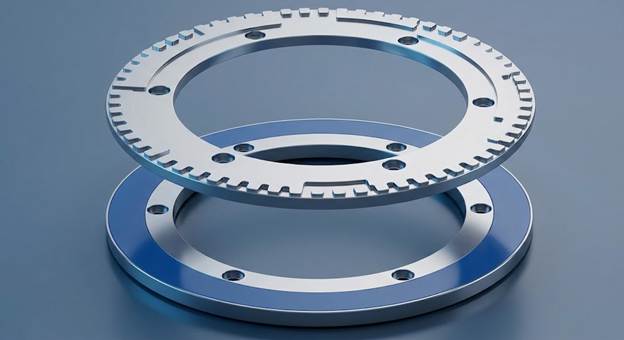
As robotic form factors become more compact, the internal space available for motion control feedback devices shrinks proportionately. Collaborative robots (cobots), medical desktop analyzers, and automated guided vehicles (AGVs) require high torque density coupled with extremely low-profile sensor integration. This constraint has forced the development of ultra-flat, frameless architectures. Modern inductive encoders address this directly, achieving thicknesses under 6 mm and total weights as low as 14g, while maintaining hollow-shaft configurations and high pulse counts.
Architectural Challenges: Resolution vs. Accuracy
A common oversight is conflating encoder resolution with accuracy. Resolution defines the smallest measurable movement (e.g., 24-bit). Accuracy defines how closely the measured position corresponds to the true physical position of the shaft, typically expressed in arcseconds.
An encoder with high resolution but low accuracy will introduce mechanical positioning errors despite detecting minute changes. Selecting the correct encoder physics requires balancing both metrics against environmental durability.
Optical Encoders for Clean Environments
Optical encoders utilize a high-frequency LED or Laser light source shining through a precisely etched glass or metal disk onto a photodetector. This architecture provides exceptionally high resolution. However, their precision makes them highly sensitive to physical contamination and mechanical shock. Microscopic dust particles, condensation, or oil mist can obscure the optical disk, leading to immediate signal loss.
Magnetic Encoders for Harsh Sectors
Magnetic encoders detect changes in a magnetic field as a magnetized rotor passes over a Hall-effect or magneto-resistive sensor. They are inherently immune to non-magnetic contaminants like heavy oil and water, routinely achieving IP67 protection ratings. While robust against shock and vibration, standard magnetic systems generally exhibit lower absolute accuracy and require complex shielding in high-EMI environments.
Inductive Encoders for High-Density Integration
Inductive encoders bridge the gap between optical accuracy and magnetic robustness. They operate by scanning the variable electrical impedance of an absolute ring. Advanced inductive sensors utilize a holistic 360-degree scanning principle. Unlike single-point scanning sensors, 360-degree reading averages out displacement, virtually eliminating eccentricity errors and radial runout. They operate completely hysteresis-free with wide mounting tolerances (e.g., axial ± 0.30 mm, radial ± 0.30 mm).
Giant Magneto Impedance (GMI®) Technology
For applications demanding the ultimate synthesis of durability and precision, Giant Magneto Impedance (GMI) technology is deployed. GMI capitalizes on the skin effect, where a material’s impedance alters significantly when exposed to external magnetic fields. GMI encoders deliver the high-precision performance of optical encoders (accuracy better than ± 4 arcseconds and up to 25-bit resolution) with the robustness of inductive encoders. They remain immune to dust, electric, and magnetic fields, requiring zero field calibration.
Technical Specifications: Precision Encoder Component Matrix
To facilitate rapid engineering specification, the following matrix outlines the core capabilities of the high-availability encoder components distributed by Torquety.
| Specification Parameter | High-Resolution Optical | Giant Magneto Impedance (GMI) | Advanced Inductive (Frameless) | Ruggedized Magnetic |
| Sensing Technology | Photoelectric Disk | Patented GMI Effect | Electromagnetic Induction (360°) | Hall-Effect / MR |
| Maximum Resolution | Up to 24-bit single-turn | Up to 25-bit single-turn | Up to 23-bit single-turn | Up to 19-bit single-turn |
| Absolute Accuracy | Very High | Up to ± 4 arcsec | Up to ± 7 arcsec (Grade G) | Medium |
| Environmental Rating | IP40 to IP54 | IP67 (Steel/Alu Housing) | IP00 (Open PCB) to IP67 | IP65 to IP67 (Sealed) |
| Operating Temperature | -20°C to +85°C | -40°C to +105°C (Extended) | -40°C to +105°C | -40°C to +105°C |
| Primary Protocols | BiSS-C, SSI, TTL/HTL | BiSS-C, SSI, SPI, A/B/Z | BiSS-C, SSI, SPI, A/B/Z | CANopen, RS422, Analog |
| Mechanical Interface | Solid / Hollow Shaft | Solid / Hollow Shaft | Ultra-Flat Frameless (<6mm) | Solid / Blind Hollow |
Application-Specific Deployment Strategies
Aerospace and Defense Topologies
Aerospace applications demand components that operate flawlessly under rapid thermal cycling and high-altitude pressure differentials. Encoders deployed in UAV gimbals rely exclusively on low-weight, frameless components that integrate directly into custom motor housings. Inductive and GMI encoders designed with extended temperature ranges spanning -40°C to +105°C protect sensitive electronics from decompression, ensuring reliable line-of-sight stabilization.
Mobile Robotics and AGV Platforms
AGVs and AMRs operate on limited battery reserves and require highly efficient drivetrain architectures. Space constraints dictate the use of ultra-compact encoders capable of precise low-speed velocity control while withstanding continuous shock. While the broader power distribution systems and motor controllers on these robots handle 12 to 60 VDC payloads, the integrated frameless inductive encoders operate on dedicated 5V logic lines to guarantee highly accurate, real-time odometry without adding mechanical weight.
Heavy Industrial Automation and Medical Devices
Heavy industrial environments (multi-axis CNC milling) subject components to constant electromagnetic interference. The electrical noise generated by plasma cutters and high-voltage servo drives easily corrupts delicate signals. GMI and frameless inductive encoders inherently reject this EMI and magnetic interference without requiring bulky external shielding. Conversely, in the medical sector, the extreme physical constraints of desktop blood analyzers and centrifuges strictly demand the 34mm OD and <6mm thickness profiles that only miniaturized inductive PCB solutions can reliably provide.
Conclusion
The deployment of advanced robotics and smart manufacturing systems relies entirely on the accuracy, durability, and availability of precision motion control feedback. While optical, magnetic, inductive, and GMI encoders each provide distinct advantages for specific environmental challenges, the universal bottleneck remains supply chain latency.
Contact Torquety’s engineering support team today to secure UK dispatch for your critical motion control hardware: contact@torquety.com
References
- Coherent Market Insights. (2025). Encoder Market Size, Share and Opportunities, 2025-2032. Global market analysis on the integration of high-precision motion feedback in smart factory deployments.
- Mordor Intelligence. (2025). Encoder Market Size, Growth, Overview & Competitive Landscape 2031. Analysis of the compound annual growth rate in absolute rotary encoders and industrial automation dependencies.
- P&S Intelligence. (2025). Encoder Market Size & Share Analysis – Trends, Drivers, Competitive Landscape, and Forecasts (2025 – 2032). Sector review of environmental tolerances and protocol integration in harsh industrial applications.