Managing wind turbines massive structures requires dynamic adjustments to handle shifting environmental forces.
At the heart of a wind turbine’s overall efficiency and structural safety lies the pitch control system. This system continuously alters the angle of the turbine blades to maximize energy capture under normal conditions and protect the entire physical structure during extreme weather anomalies.
To make this seamless adjustment possible, electrical power and data must pass continuously between moving parts. The pitch control slip ring serves as the vital bridge connecting the stationary nacelle to the rotating hub.
These are not standard, off-the-shelf components ; they are highly specialized rotary joints engineered to transmit mission-critical power and data signals under some of the most unforgiving environments on Earth.
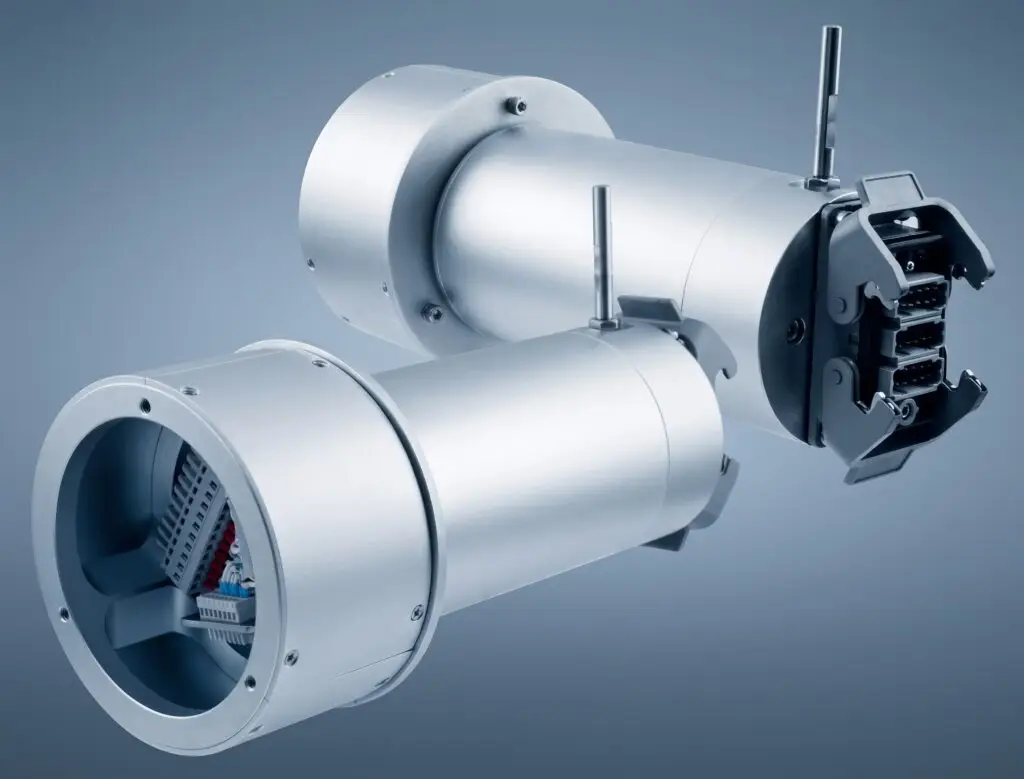
The Engineering Challenge
Operating hundreds of feet in the air or miles out at sea, wind turbine slip rings must endure intense operational and environmental stresses day in and day out.
Key Operational Stressors:

Secure Your Components Stock Now with Torquety
Reliable automation components for high-performance applications.
- Continuous, uninterrupted mechanical rotation.
- High levels of structural vibration and mechanical shock.
- Drastic, rapid ambient temperature fluctuations.
Because these systems are deployed in incredibly tough field environments, they require an extended operational temperature range as well as specialized surface treatments.
These surface treatments are necessary to reduce external electrical noise and prevent severe material corrosion. Additionally, turbine architecture imposes strict spatial constraints: engineers must maintain a ruggedized circuit design within an extremely compact footprint while keeping the total weight of the assembly to an absolute minimum.
Key Technical Specifications
To reliably withstand these demanding conditions, manufacturers rely on custom-engineered slip ring solutions tailored to specific turbine profiles. Below is a breakdown of technical features commonly integrated into high-performance wind turbine slip ring configurations:
| Feature | Specification / Detail |
| Circuitry | Up to 27 individual circuits designated for complex signal and power routing. |
| Data Transmission | 2 channels of CANopen protocol for reliable, high-speed communication of power and data signals. |
| Environmental Protection | Minimum IP54 sealing to protect internal components against dust and moisture ingress. |
| Operating Temperature | Rated for extreme climates ranging from -40°C to +80°C. |
| Internal Climate Control | Integrated anti-condensation heaters to prevent moisture and condensation buildup inside the housing. |
| Connectivity | Specialized, compact connectors fitted to minimize space requirements and facilitate easy field installation. |
Advancements in Pitch Slip Ring Design
Modern pitch control slip rings are evolving far beyond simple electrical contact assemblies. The wind energy sector is actively shifting toward fully integrated mechatronic systems:
- Encoder Integration: For highly accurate pitch indexing, the main control loop needs real-time position data from rotating elements. Advanced slip ring assemblies seamlessly embed absolute inductive encoders (such as the Zettlex incOder) directly into the main mechanical housing. This creates a unified package handling power, telemetry data, and absolute position feedback simultaneously.
- Architecture Variations: Depending on the specific nacelle layout and environmental hazards, turbine designers utilize different form factors. They can implement extremely compact, high-current capsule slip rings (such as the Servotecnica A Series) for tight spaces , or open-style slip rings (such as the E Series) which offer top-tier performance and easy system integration at a competitive price point for areas with lower contamination risks.
- Hybrid Combined Systems: To support multi-functional data or auxiliary fluid power requirements, these electrical slip rings can be combined into a single cohesive interface alongside fluidic rotary joints or Fiber Optic Rotary Joints (FORJ). This design yields an unlimited number of media routing combinations across a single mechanical turning point.
Summary
The pitch control slip ring remains a fundamental lifeline inside the wind turbine nacelle. It provides the lightning-fast data throughput and robust power distribution required to keep massive rotor blades turning safely, reliably, and efficiently. By merging ruggedized component materials, integrated anti-condensation systems, and embedded position encoders, manufacturers ensure that modern wind deployment can continue pushing the limits of renewable power generation.
Source Your Slip Ring from Torquety — Official UK Distributor
Torquety distributes and supplies Mechatronic Components from our London headquarters, providing engineers across the UK with fast access to verified, in-stock components. We stock Slip Ring units ready for next-day dispatch from UK stock — no long international lead times. Whether you need one unit or a volume order, Torquety delivers the exact specification your application demands.
Source Your Slip Ring from Torquety — Official UK Distributor
Torquety distributes and supplies Mechatronic Components from our London headquarters, providing engineers across the UK with fast access to verified, in-stock components. We stock Slip Ring units ready for next-day dispatch from UK stock — no long international lead times. Whether you need one unit or a volume order, Torquety delivers the exact specification your application demands.
Source Your Slip Ring from Torquety — Official UK Distributor
Torquety distributes and supplies Mechatronic Components from our London headquarters, providing engineers across the UK with fast access to verified, in-stock components. We stock Slip Ring units ready for next-day dispatch from UK stock — no long international lead times. Whether you need one unit or a volume order, Torquety delivers the exact specification your application demands.
Need a Custom Component Solution?
Contact our engineering team to discuss your application requirements and get a custom quote.