In the arenas of modern defense, aerospace surveillance, and robotic inspections, Electro-Optical/Infrared (EO/IR) gimbals serve as critical visual hubs. These highly engineered payload tracking systems demand unrestricted 360º continuous rotation to monitor environments seamlessly across land, naval, and aerospace applications.
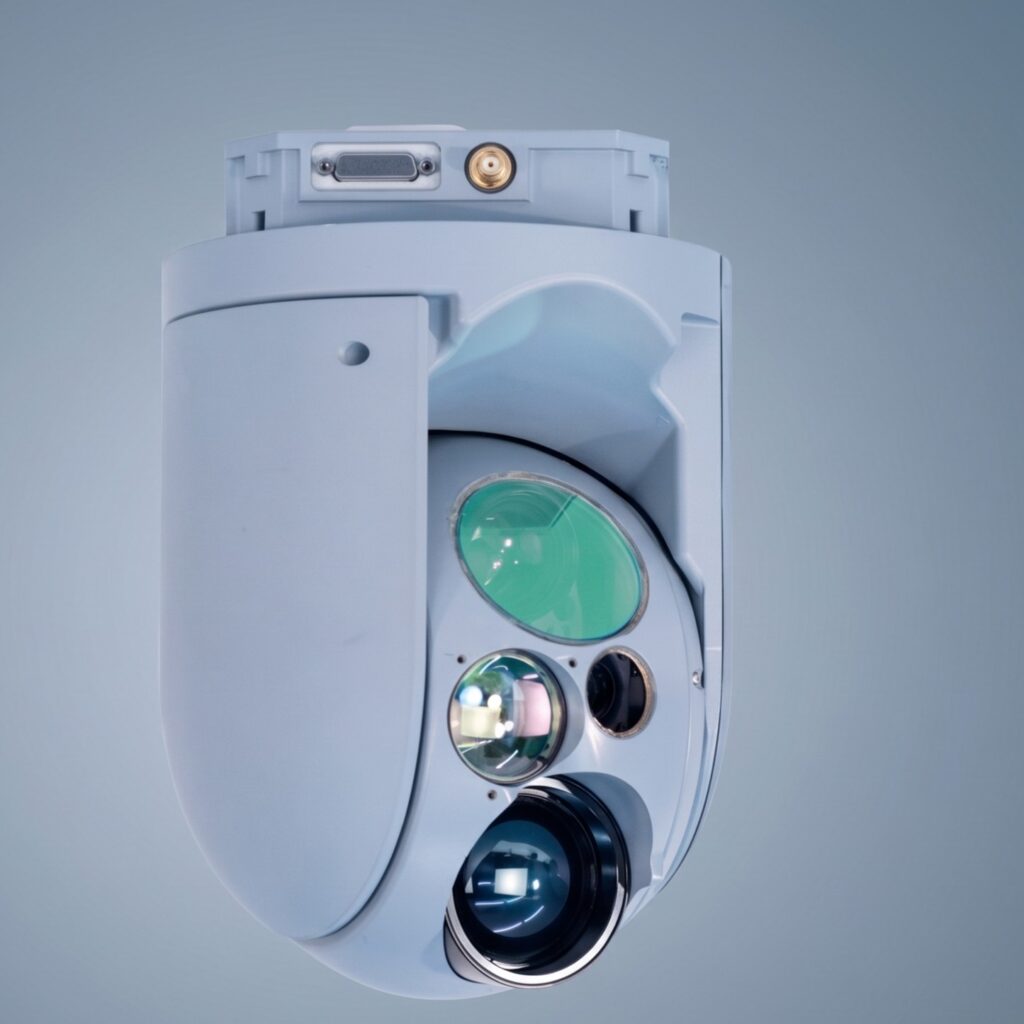
However, spinning a high-definition payload continuously creates a complex engineering roadblock: how do you transmit massive streams of high-bandwidth data and sensitive sensor currents across a rotating interface without twisting the wires?
The answer lies in specialized EO/IR gimbal slip rings.
The Engineering Challenge: Precision in Harsh Environments
Operating on unmanned aerial vehicles (UAVs), armored ground vehicles, or maritime patrol vessels, EO/IR gimbal slip rings must perform flawless data routing under severe mechanical and environmental stresses.
1. Tight Spatial Footprints and Weight Constraints
Engineers face a strict mandate to compress rugged multi-circuit capabilities into minimized geometric configurations. Minimizing total assembly weight is critical to preserve the flight dynamics of airborne platforms or the battery lifecycle of mobile robotics.
2. High Circuit Density and Noise Reduction
A modern gimbal platform houses a dense matrix of electrical circuits. Coexisting alongside raw power channels are low-current sensor feeds, telemetry loops, and high-frequency communication protocols. Preventing crosstalk and external electrical noise from distorting high-definition thermal or optical imagery requires proprietary shielding and specialized surface treatments.
3. Strict Ruggedization Requirements
Platform components must withstand continuous rotation, high structural vibrations, mechanical shocks, and drastic temperature fluctuations. They must also feature an extended operational temperature range to reliably survive everything from desert deployments to high-altitude cold.

Secure Your Components Stock Now with Torquety
Reliable automation components for high-performance applications.
Architectural Variations: Capsule vs. Through-Bore Slip Rings
Designers select slip ring form factors based directly on the mechanical layout of the gimbal assembly:
| Slip Ring Type | Structural Characteristic | Ideal Application |
| Capsule Slip Rings | Compact, enclosed designs emphasizing a tiny outer diameter and low peripheral speed. Features optimized signal paths. | Ideal for space-constrained tracking optics, drone antennas, and small-footprint sensor pods. |
| Through-Bore Slip Rings | Hollow-shaft configuration providing a central clearing hole. | Engineered to route structural shafts, gas lines, or centralized fluidic piping directly through the spinning axis. |
Key Technical Specifications for High-Performance Gimbals
When customizing a slip ring interface for a mission-critical EO/IR payload, technical specialists target several distinct specifications based on successful custom configurations:
- Circuit Optimization: Standard tracking joints easily deploy mixed configurations with up to 10 power paths and 55 independent signal paths.
- High-Speed Data & Protocols: Seamless execution of high-definition video signals (such as 1080p/3G-SDI) along with industrial bus lines like CANopen to guarantee real-time telemetry communication.
- Gold-on-Gold Contact Technology: Utilizing gold-to-gold brush-and-ring interfaces yields minimal dynamic contact resistance (<10mΩ), suppressing electrical noise while extending operational life to millions of revolutions.
- Robust Thermal Tolerance: Certified operation across an extended window of -40ºC to +80ºC to withstand extreme environmental field shifts.
Advanced Mechatronic and Hybrid Material Innovations
Modern gimbal designs are moving away from stand-alone electrical junctions toward highly integrated mechatronic setups.
Embedded Absolute Encoders
For hyper-accurate targeting indexation, the gimbal’s primary control loops require real-time position telemetry directly from rotating mechanics. Advanced slip rings embed compact absolute inductive encoders directly into the outer structural housing. This creates a single hardware envelope that delivers clean power transmission, system data routing, and high-resolution position feedback simultaneously.
Contactless Fibre Optic Rotary Joints (FORJ)
When modern high-resolution payloads exceed the bandwidth capacity of copper channels, optical fiber steps in. Integrated configurations combine copper rings with multi-mode or single-mode contactless FORJs. This architecture enables rapid 3G-SDI video multiplexing and high-speed Ethernet routing across a single turning junction, ensuring near-infinite component life and zero signal degradation.
Summary
Selecting or specifying a slip ring for an EO/IR gimbal platform is a balancing act between spatial constraints, data bandwidth, and ruggedization. By using gold-on-gold metallurgy, integrated position tracking sensors, and option-ready hybrid fiber connections, modern manufacturers build dependable lifelines that keep high-definition payloads tracking smoothly in any operational scenario.
Source Your Slip Ring from Torquety — Official UK Distributor
Torquety distributes and supplies Mechatronic Components from our London headquarters, providing engineers across the UK with fast access to verified, in-stock components. We stock Slip Ring units ready for next-day dispatch from UK stock — no long international lead times. Whether you need one unit or a volume order, Torquety delivers the exact specification your application demands.
Source Your Slip Ring from Torquety — Official UK Distributor
Torquety distributes and supplies Mechatronic Components from our London headquarters, providing engineers across the UK with fast access to verified, in-stock components. We stock Slip Ring units ready for next-day dispatch from UK stock — no long international lead times. Whether you need one unit or a volume order, Torquety delivers the exact specification your application demands.
Source Your Slip Ring from Torquety — Official UK Distributor
Torquety distributes and supplies Mechatronic Components from our London headquarters, providing engineers across the UK with fast access to verified, in-stock components. We stock Slip Ring units ready for next-day dispatch from UK stock — no long international lead times. Whether you need one unit or a volume order, Torquety delivers the exact specification your application demands.
Need a Custom Component Solution?
Contact our engineering team to discuss your application requirements and get a custom quote.