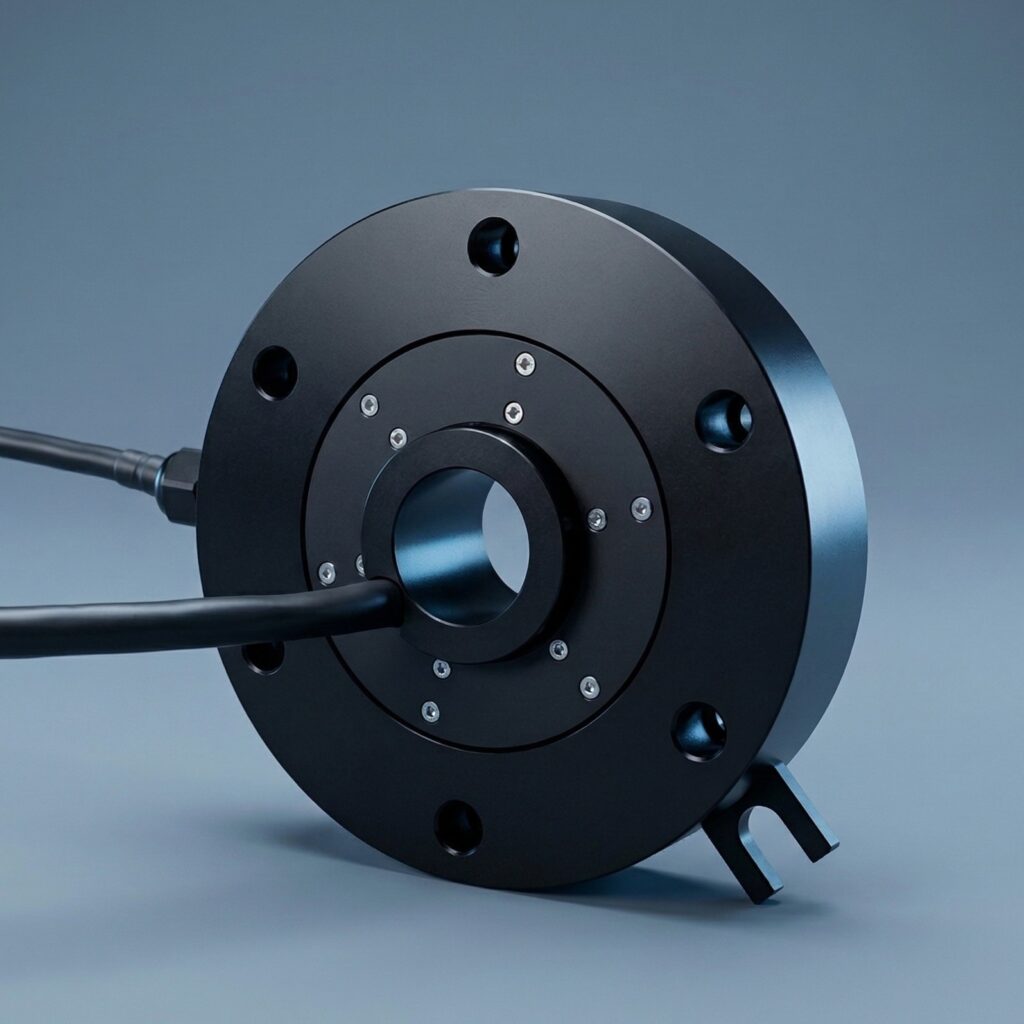
In electromechanical system design, routing power and signal channels across a continuously rotating interface often introduces severe spatial constraints. Standard capsule or through-bore geometries require axial depth to accommodate multiple isolated circuits stacked along the rotation axis.
When mechanical boundaries strictly limit axial height, a flat slip ring (pancake profile) provides a planar alternative by arranging the conductive tracks concentrically rather than lineally. This article details the specific mechanical boundaries, electrical ratings, and operational limits governing these flat configurations.
Flat Slip Ring Radial and Axial Configurations
The mechanical footprint of a flat slip ring represents a complete inversion of typical through-bore dimensions, trading outer diameter for a highly compressed axial length.
The structural geometry is defined by the following dimensional and circuit parameters:
- Internal Diameter (): 40 mm (1.57 inches).
- Total Circuit Capacity: Fixed at 20 circuits.
This specific dimensional boundary allows designers to pass mechanical shafts, fluid lines, or structural members through the center 40 mm aperture while maintaining 20 independent electrical pathways within a flat, low-profile envelope.

Secure Your Components Stock Now with Torquety
Reliable automation components for high-performance applications.
Electrical and Environmental Transmission Metrics
To ensure signal integrity and power transmission capability across concentric tracks, the components adhere to standardized electrical and structural constraints. The product coding and options matrix defines the baseline and extended operating parameters for these rotary joints:
- Dielectric Strength: 500 VAC at 60 Hz for a duration of 60 seconds.
- Insulation Resistance: Greater than 500 MΩ at 500 VDC.
- Dynamic Contact Resistance: Maintained below mΩ during rotation.
- Voltage Rating: 240 VDC / 240 VAC.
- Nominal Rotational Speed: Up to 500 rpm.
The physical interface utilizes a gold-gold contact technology for both the rings and the brushes. This metallurgical selection limits the dynamic contact resistance and manages electrical noise during high-duty-cycle operations.
Operational Impact and Environmental Edge Cases
Integrating a flat slip ring requires precise mapping of environmental conditions and cable management constraints. Based on the documentation’s part numbering logic, the physical build configuration must align with specific operational environments.
- Temperature Scaling: The standard operating temperature range (ST) spans from -20°C to +80°C. For low-temperature environments, an extended temperature range (ET) option expands survival and operational limits down to -40°C up to +80°C.
- Ingress Protection (IP Grading): Depending on the containment housing and environmental exposure, the systems are graded from IP00 (completely open or unshielded) up to IP65 (water-resistant aluminum or specialized enclosures). The primary intermediate standard for sealed variants is IP51.
- Cable Specification and Modularity: Circuits are wired using silver-plated, PTFE-insulated, color-coded conductors.
Source Your Slip Ring from Torquety — Official UK Distributor
Torquety distributes and supplies Mechatronic Components from our London headquarters, providing engineers across the UK with fast access to verified, in-stock components. We stock Slip Ring units ready for next-day dispatch from UK stock — no long international lead times. Whether you need one unit or a volume order, Torquety delivers the exact specification your application demands.
Source Your Slip Ring from Torquety — Official UK Distributor
Torquety distributes and supplies Mechatronic Components from our London headquarters, providing engineers across the UK with fast access to verified, in-stock components. We stock Slip Ring units ready for next-day dispatch from UK stock — no long international lead times. Whether you need one unit or a volume order, Torquety delivers the exact specification your application demands.
Source Your Slip Ring from Torquety — Official UK Distributor
Torquety distributes and supplies Mechatronic Components from our London headquarters, providing engineers across the UK with fast access to verified, in-stock components. We stock Slip Ring units ready for next-day dispatch from UK stock — no long international lead times. Whether you need one unit or a volume order, Torquety delivers the exact specification your application demands.
Need a Custom Component Solution?
Contact our engineering team to discuss your application requirements and get a custom quote.