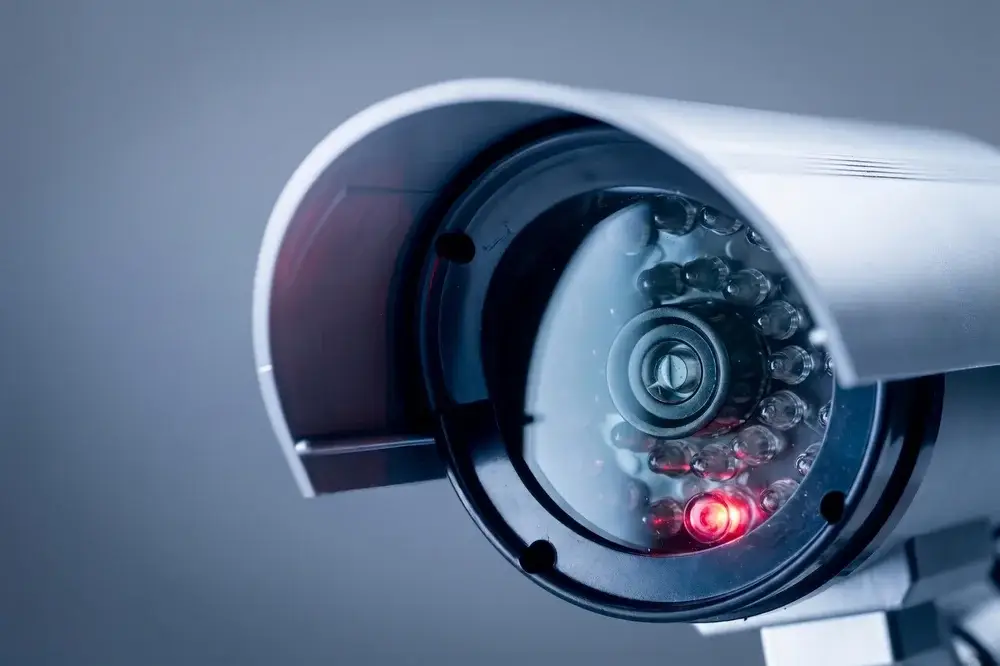
Surveillance technology has evolved significantly from the grainy, static CCTV cameras of the past. Today’s security matrices rely on fast, ultra-agile Pan-Tilt-Zoom (PTZ) dome cameras and automated multi-axis gimbals that demand an uncompromised, full 360-degree field of view.
But, how do you keep a high-definition camera spinning continuously without twisting its internal power and telemetry cables into a plastic knot?
The answer lies in a tiny, unsung marvel of mechatronics: the capsule slip ring. Serving as a continuous rotary bridge, it passes power and complex high-frequency data from a fixed mount to an endlessly rotating camera head without dropping a single frame.
The Engineering Challenge: Continuous Rotation Without Blind Spots
Traditional hard-wired connections limit panning mechanisms, cause mechanical strain, and eventually break under the stress of constant oscillation. In security and high-definition observation systems, any structural or wiring failure creates a critical blind spot.
By deploying a stationary brush assembly that lightly interfaces with a series of conductive rotating rings, slip rings facilitate a seamless electrical transition across a 360-degree turning point. This enables continuous rotation, maximizing security coverage and completely wiping out cable fatigue.
Key Technical Requirements for Surveillance Slip Rings
Security and video tracking configurations subject internal components to demanding environments. Not all rotary joints are created equal; high-performance surveillance systems require specific technical profiles:
1. Uncompressed High-Definition Video Feed Transmission (HD-SDI & 3G-SDI)
Modern security grids demand extreme visual clarity for facial recognition and analytics. Dedicated radio frequency (RF) capsule slip rings are engineered specifically to transfer crisp, uncompressed high-definition video feeds like 1080i/HD-SDI or 1080p/3G-SDI over single rotating points. These components integrate high-frequency coaxial lines capable of running up to 3 GHz and interface with standardized RF coaxial cables like the RG174, RG316, and RG178 series.

Secure Your Components Stock Now with Torquety
Reliable automation components for high-performance applications.
2. High-Grade Gold-on-Gold Contacts
To prevent sensitive digital packets from shattering into noise and pixelated artifacts, the contact physical layer must be exceptionally clean.
- Integrating premium gold-to-gold contact technology for both rings and brushes minimizes ring-to-ring interference and electrical resistance.
- This material optimization provides the ultra-low dynamic contact resistance required for fast signal transmission speeds.
3. Compact and Lightweight Architecture
Space inside a ceiling dome or an inspection drone antenna is a hot commodity.
- Surveillance-grade capsule slip rings feature vastly reduced outer diameters (often between 12mm and 25mm), making them perfectly compact for tight device hulls.
- Their light construction reduces total payload weight, enabling smaller pan-tilt motors to operate with maximum agility.
- Additionally, a smaller diameter minimizes the peripheral sliding speed between the brushes and rings, drastically curbing material wear and compounding the component’s operational lifetime.
4. High Circuit Density in a Single Package
A modern security camera does not just transmit video. It requires distinct lines for power distribution, pan/tilt directional control, automated focus optics, and peripheral telemetry feeds. High-density capsule architectures can comfortably bundle anywhere from 3 up to 56 independent circuits into a single miniature housing.
Performance Matrix: Capsule vs. Radio Frequency (RF) Designs
The choice between standard capsule slip rings and specialized RF models depends heavily on your system’s data architecture:
| Operational Feature | Standard Capsule Slip Rings (e.g., SVTS A Series) | Radio Frequency (RF) Capsule Slip Rings |
| Primary Structural Benefit | High circuit density in a miniature footprint | Crisp, zero-decay high-definition video transmission |
| Contact Metallurgy | Optimized gold-on-gold signal paths | Gold-on-gold paired with a coaxial connection |
| Maximum Frequency | Standard low-frequency data / fieldbuses | High-speed channels running up to 3 GHz |
| Supported Protocols | Power, control signals, Ethernet, EtherCAT | 1080p/3G-SDI and 1080i/HD-SDI streams |
| Circuit Configuration | Scalable variations from 3 to 56 circuits | Up to 24 standard signal lines plus an RF channel |
Weatherproofing for Punishing Environments
From exposed coastal borders to blazing desert intersections, outdoor surveillance hardware faces extreme conditions. Premium slip ring designs integrate protective mechanics to stay online regardless of the weather:
- Broad Temperature Thresholds: Standard operational configurations are rated to perform seamlessly from -20°C up to +80°C, with extended sub-zero options available for arctic deployments.
- Ingress Protection (IP Sealing): While indoor cameras can use standard IP51 models , outdoor PTZ cameras rely on upgraded IP65 water-resistant enclosures to completely block dust particles and low-pressure water streams from entering the casing.
- Bearing Durability: Incorporating miniature, high-precision stainless steel ball bearings helps components achieve a maintenance-free expected lifetime of $3 times 10^6$ to $10^7$ continuous revolutions.
When designing or sourcing hardware for outdoor security systems, look for a slip ring that balances an IP65 water-resistant seal with gold-gold fiber brush technology. This combination prevents micro-corrosion from humidity, eliminating the signal jitter that disrupts remote PTZ commands, and lowering your long-term truck-roll and maintenance costs.
Final Thoughts
Whether you are configuring an AI-driven city traffic grid, a naval thermal targeting gimbal, or an automated robotic inspection vehicle, a high-quality slip ring is a critical component. By shrinking high circuit densities and robust signal optimization into a compact, weather-shielded capsule, these clever components ensure your security infrastructure stays spinning cleanly-leaving nowhere for threats to hide.
Source Your Slip Ring from Torquety — Official UK Distributor
Torquety distributes and supplies Mechatronic Components from our London headquarters, providing engineers across the UK with fast access to verified, in-stock components. We stock Slip Ring units ready for next-day dispatch from UK stock — no long international lead times. Whether you need one unit or a volume order, Torquety delivers the exact specification your application demands.
Source Your Slip Ring from Torquety — Official UK Distributor
Torquety distributes and supplies Mechatronic Components from our London headquarters, providing engineers across the UK with fast access to verified, in-stock components. We stock Slip Ring units ready for next-day dispatch from UK stock — no long international lead times. Whether you need one unit or a volume order, Torquety delivers the exact specification your application demands.
Source Your Slip Ring from Torquety — Official UK Distributor
Torquety distributes and supplies Mechatronic Components from our London headquarters, providing engineers across the UK with fast access to verified, in-stock components. We stock Slip Ring units ready for next-day dispatch from UK stock — no long international lead times. Whether you need one unit or a volume order, Torquety delivers the exact specification your application demands.
Need a Custom Component Solution?
Contact our engineering team to discuss your application requirements and get a custom quote.