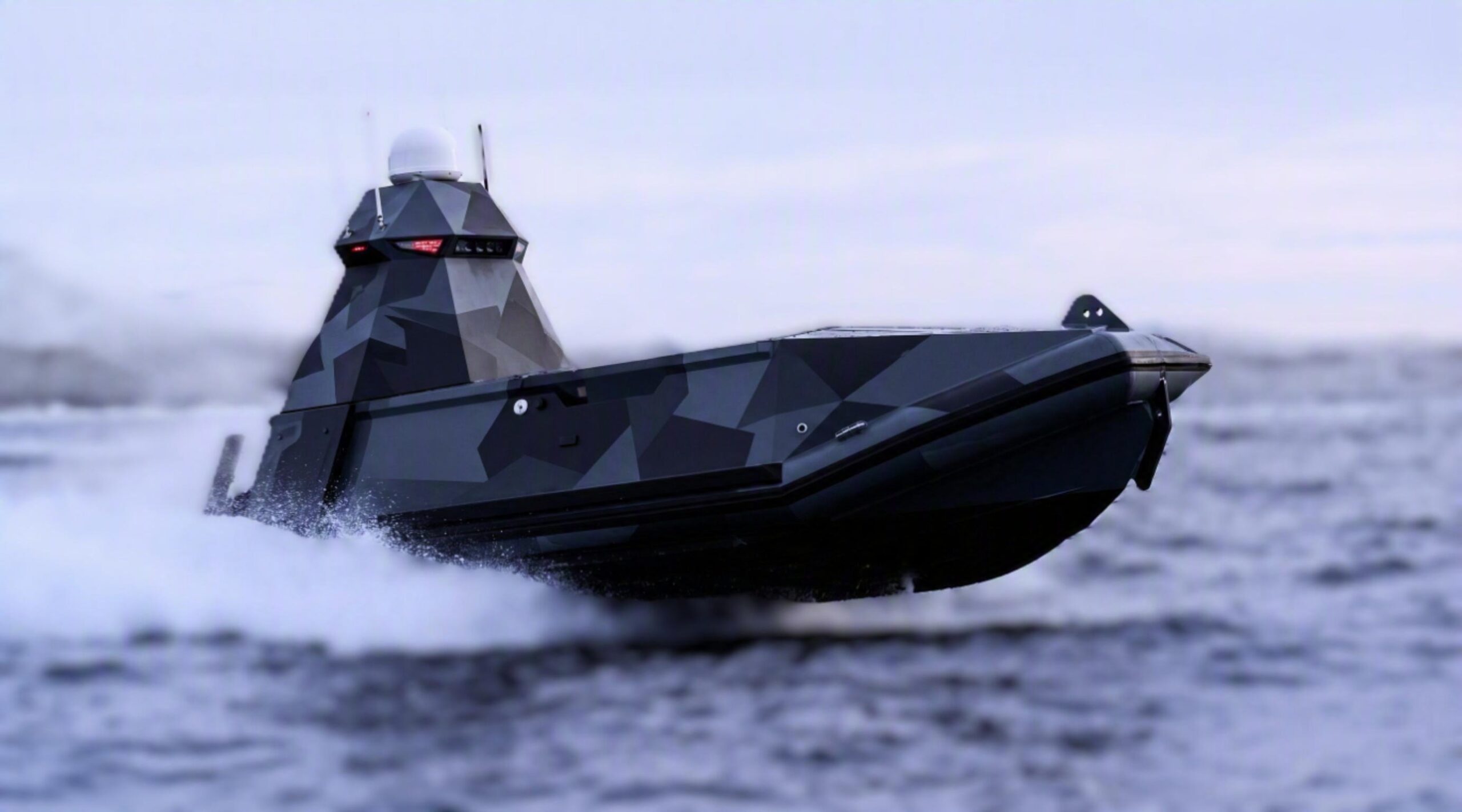
Offshore energy platforms, subsea remotely operated vehicles (ROVs), and naval steering gear operate in relentless environments where saltwater spray, high pressure, and biofouling destroy standard industrial sensors. To address these challenges, Austrian precision encoder company FLUX GmbH has introduced the FLUX IND-MAX-100 Marine Grade inductive angle encoder. Featuring a housing crafted from marine-grade stainless steel and designed for continuous saltwater immersion, this encoder provides unmatched position feedback where conventional optical or capacitive sensors fail.
💡 Lead Editor’s Engineering Insight
Inductive sensing operates completely unaffected by fluid immersion. Even if saltwater, engine oils, mud, or biofilm enter the rotor-stator air gap, the electromagnetic inductive coupling remains 100% precise. Because the technology does not rely on a clean optical path or a stable dielectric constant in the gap, it offers a physics-based immunity to liquid contamination.

Secure Your Components Stock Now with Torquety
Reliable automation components for high-performance applications.

Why Inductive Technology Wins Over Optical & Capacitive
When integrating feedback sensors into marine and offshore motion control systems, design engineers must balance positional resolution against real-world mechanical tolerances and environmental extremes.
- The Optical Failure Mode: Traditional optical glass disc encoders require precise axial alignment and absolute seals. If condensation, saltwater spray, or grease enters the air gap, the light path is blocked, leading to immediate sensor failure or signal loss.
- The Capacitive Failure Mode: Capacitive encoders are highly sensitive to changes in the dielectric constant in the stator-rotor air gap. A single droplet of water or condensation shifts the dielectric profile, distorting the signal and rendering position readings useless.
- The Magnetic Failure Mode: Magnetic encoders provide environmental ruggedness but are susceptible to magnetic interference from heavy-duty electric motors, thrusters, and naval electrical systems, often introducing position drift and hysteresis.
- The Inductive Advantage: FLUX Inductive technology uses alternating electromagnetic fields. The rotor and stator are electromagnetically coupled. Fluids and non-magnetic materials (water, oil, mud) are transparent to these fields, resulting in a system that is entirely immune to contamination while offering optical-grade precision.
“FLUX encoder technology bridges the gap between optical-grade precision and magnetic-grade robustness, delivering absolute position feedback in the most challenging maritime and industrial environments.”
Specialized Marine & Subsea Design Options
The standard FLUX IND-MAX encoder line is constructed with anodized aluminum components (Option -AL). However, for marine, naval, and subsea actuation, FLUX provides specialized build options to withstand extreme environmental challenges:
- Marine-Grade Stainless Steel Housing: The specialized IND-MAX-100 Marine Grade variant features a housing made entirely of marine-grade stainless steel. This provides exceptional resistance to pitting, crevice corrosion, and mechanical impacts in offshore and naval environments.
- IP68 Continuous Submersion (Option “W”): Standard IND-MAX encoders feature IP67 protection. Specifying Option “W” upgrades the sealing to IP68, certifying the encoder for continuous, long-term underwater immersion in seawater or hydraulic fluids.
- 200-Bar Subsea Pressure Rating (Option “H”): While standard industrial encoders are restricted to atmospheric pressure (or up to 7 bars), Option “H” certifies the encoder for operations up to 200 bars. This enables integration into deep-sea ROVs, AUVs, and subsea thrusters operating at depths of up to 2,000 meters.
- Surface Plating (Option “N”): For aluminum-housed models, Option “N” replaces the standard anodized surface with Electroless Nickel Plating. This provides a highly conductive, corrosion-resistant surface finishing that enhances EMC shielding and system grounding.
- Extended Temperature Range (Option “E”): Upgrades the operational temperature range from standard (-20°C to +85°C) to -45°C to +105°C (with storage down to -55°C), which is ideal for aerospace, arctic offshore, or transition environments.
Expanded Sizing & Application Versatility
To support a wider range of integration needs, FLUX recently expanded the IND-MAX range to include 75mm and 100mm outer diameter (OD) options. These compact sizes allow designers to package high-precision feedback into smaller envelopes. The full scalability of the IND-MAX family is detailed below:
- Hollow-Bore Diameters: Available in 75, 100, 125, 160, 180, 200, 250, 300, and 375 mm sizes, featuring massive through-holes to accommodate slip rings, cabling, or mechanical shafts.
- Key Maritime Applications:
- Stabilized sensor platforms (gimbals) on ships, drones, and helicopters.
- Subsea robotics, manipulator arms, and AUV/ROV steering gear.
- Offshore winches, cranes, and heavy-lift energy equipment.
- Naval defense systems, aiming mounts, and security tracking cameras.
Comprehensive Specification & Capability Matrix
| Parameter | Standard Industrial Encoder | Torquety / FLUX IND-MAX Series (inc. Marine) |
|---|---|---|
| Ingress Protection Rating | IP65 (Splash proof) | IP67 (Standard) | IP68 / IP69K (Option W – Submersion) |
| Housing Material | Aluminum / Plastic anodized | Marine-Grade Stainless Steel (IND-MAX-100 Marine) or Anodized Aluminum with Electroless Nickel Plating (Option N) |
| Salt Spray & Fluids | Pitting & seal degradation | Immune to saltwater oxidation and fluid in air gap |
| Operating Pressure | 1 bar (Atmospheric) | 0.05 to 7 bar (Standard) | 0.05 to 200 bar (Option H – up to 2,000m subsea) |
| Temperature Range | -10°C to +70°C | -20°C to +85°C (Standard) | -45°C to +105°C (Option E – Extended) |
| Shock & Vibration | 50g shock / 5g vibration | 200g shock (6ms) | 20g vibration (55 .. 2000Hz) |
| Max Output Resolution | 16-bit to 18-bit | 21-bit (sizes 75-125) | 22-bit (sizes 160-180) | 23-bit (sizes 200-375) |
| Rotational Accuracy | ±144 to ±300 arcseconds | Down to ±10 arcseconds | Down to ±7 arcseconds (Grade G High Accuracy Option C) |
| Mounting Tolerances | ±0.05 mm (Requires calibration) | Axial: ±0.30 mm | Radial: 0.20 mm (Plug-and-play, no field calibration) |
| Hysteresis | Hysteresis present | Hysteresis-free (360° holistic scan) |
Connectivity, Cabling & Control Interfaces
To ensure seamless integration with modern industrial controllers, PLCs, and robotic motion systems, the FLUX IND-MAX series supports a wide range of output interfaces:
- Absolute Interfaces: Support for high-speed synchronous protocols including BiSS-C (BIS10, BIS21) and SSI (SSI00 to SSI04, SSI11, SSI20) to output true absolute position data in real-time. SPI and Asynchronous interfaces (UAT00, UAT10) are also available.
- Incremental Output: Supported via incremental INCxx (A/B/Z) configurations for standard quadrature feedback.
- Integrated Cabling Options:
- Option “K01” PUR Cable: High-durability polyurethane jacket optimized for drag chains and continuous motion. Temperature range from -40°C to +90°C dynamic (-50°C to +90°C static). Includes integrated ZERO+/- wires to easily set the encoder zero position in the field.
- Option “K02” Silicone Cable: Engineered for extreme temperature flexibility, rated from -25°C to +180°C dynamic (-60°C to +180°C static), utilizing FEP wire isolation.
Selecting the Right Encoder for Your Application
Whether designing a high-altitude defense gimbal, a subsea actuator for deep-ocean research, or an offshore winch for wind farm construction, the FLUX IND-MAX series provides the mechanical flexibility and electrical reliability required for high-performance closed-loop motion control. By eliminating mechanical bearings, the encoders are completely maintenance-free, offering long-term reliability and reducing the total cost of ownership.
Need a Custom Component Solution?
Contact our engineering team to discuss your application requirements and get a custom quote.