Encoders

Encoder Interpolation: From Sinusoidal Output to Position Counts

Interpolation is the mathematical process that subdivides the grating period of an optical or capacitive encoder into position counts finer than the physical line pitch. Understanding interpolation electronics — including the arctangent algorithm, signal conditioning requirements, and error sources — enables accurate specification of achievable resolution at a given signal quality.

Encoder Interpolation: From Sinusoidal Output to Position Counts Read More »

Encoder Technology for Surgical Robotics: Accuracy, Safety, and Sterilization Constraints

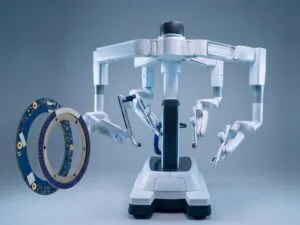
Surgical robotic systems impose the tightest combination of encoder requirements: absolute position without homing, high accuracy in a compact hollow-shaft form factor, functional safety certification, and compatibility with sterilization processes. Optical and capacitive sensing technologies dominate this application class for clearly defined engineering reasons.

Encoder Technology for Surgical Robotics: Accuracy, Safety, and Sterilization Constraints Read More »

Optical Encoder Technology: Wide-Area Sensing for Industrial Reliability

Verapath optical encoder technology uses a large-area illumination and detection system with a low-coherence LED source to achieve contamination tolerance without sacrificing accuracy. This article describes the sensing architecture, signal quality characteristics, and the reliability advantages of the wide-area approach for industrial environments.

Optical Encoder Technology: Wide-Area Sensing for Industrial Reliability Read More »

Rotary Position Sensors vs. Resolvers: Technical Comparison for High-Temperature Applications

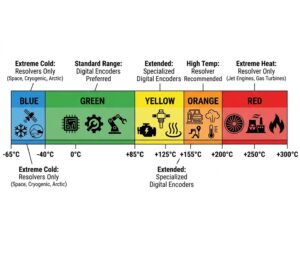
Resolvers and modern digital rotary encoders both provide angular position feedback for servo motors. Resolvers dominate applications above 150°C operating temperature where encoder electronics would fail. Below 150°C, digital encoders provide better resolution, direct digital output, and lower system integration cost. This article defines the boundary conditions for each technology.

Rotary Position Sensors vs. Resolvers: Technical Comparison for High-Temperature Applications Read More »

Rotary Encoders for SATCOM Antenna Pointing Systems: Requirements and Technology Selection

SATCOM antenna pointing systems require absolute position feedback with high accuracy, wide temperature range, and immunity to EMI from the antenna itself. This article defines the pointing accuracy budget, environmental constraints, and encoder technology selection for SATCOM-on-the-Move (SOTM) and fixed SATCOM systems.

Rotary Encoders for SATCOM Antenna Pointing Systems: Requirements and Technology Selection Read More »

Rotary Encoder Selection for CNC Machine Tools: Resolution, Accuracy, and Interface Requirements

CNC machine tool axis position feedback requirements differ from general motion control applications in their combination of high resolution, tight accuracy specification, wide speed range, and tolerance for machining coolant. This article defines the encoder parameters required for CNC servo axis, spindle speed, and linear position feedback applications.

Rotary Encoder Selection for CNC Machine Tools: Resolution, Accuracy, and Interface Requirements Read More »

Torque Motor Direct Drive Systems: Encoder Requirements for High-Pole-Count Motors

Torque motors are frameless, high-pole-count brushless motors designed for direct drive without gear reduction. Position feedback for torque motors requires absolute encoders with sufficient resolution to provide commutation data across the large number of pole pairs, while achieving the axis accuracy required by the application.

Torque Motor Direct Drive Systems: Encoder Requirements for High-Pole-Count Motors Read More »