How to Get Servotecnica Slip Rings in the UK. A Guide to Rotary Power and Signal Transmission
Every rotating system that needs to transmit electrical power, data signals, Ethernet communications, or fluid media from a stationary structure […]
Every rotating system that needs to transmit electrical power, data signals, Ethernet communications, or fluid media from a stationary structure […]
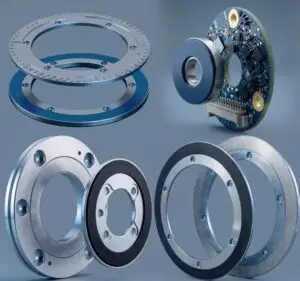
If you are a design engineer, systems integrator, or procurement manager in the United Kingdom searching for a high-precision position
How to Get FLUX Encoders in the UK. A Guide to GMI® and Inductive Position Feedback Read More »
Interpolation is the mathematical process that subdivides the grating period of an optical or capacitive encoder into position counts finer than the physical line pitch. Understanding interpolation electronics — including the arctangent algorithm, signal conditioning requirements, and error sources — enables accurate specification of achievable resolution at a given signal quality.
Encoder Interpolation: From Sinusoidal Output to Position Counts Read More »
Selecting a rotary encoder for a motion control application requires systematically working through environment, accuracy, form factor, protocol, and lifecycle constraints. This article provides a structured decision tree with specific technology recommendations at each branch point.
Rotary Encoder Selection Framework: A Decision Tree for Motion Control Engineers Read More »
Surgical robotic systems impose the tightest combination of encoder requirements: absolute position without homing, high accuracy in a compact hollow-shaft form factor, functional safety certification, and compatibility with sterilization processes. Optical and capacitive sensing technologies dominate this application class for clearly defined engineering reasons.
Carbon brush wear in slip rings is predictable and measurable. Replacement intervals depend on current density, rotational speed, and operating temperature. This article defines the indicators of brush wear, the maintenance procedure for carbon brush replacement, and preventive inspection schedules to prevent unplanned failures.
Slip Ring Maintenance: Carbon Brush Replacement Intervals and Service Procedures Read More »
Verapath optical encoder technology uses a large-area illumination and detection system with a low-coherence LED source to achieve contamination tolerance without sacrificing accuracy. This article describes the sensing architecture, signal quality characteristics, and the reliability advantages of the wide-area approach for industrial environments.
Optical Encoder Technology: Wide-Area Sensing for Industrial Reliability Read More »
Resolvers and modern digital rotary encoders both provide angular position feedback for servo motors. Resolvers dominate applications above 150°C operating temperature where encoder electronics would fail. Below 150°C, digital encoders provide better resolution, direct digital output, and lower system integration cost. This article defines the boundary conditions for each technology.
At rotational speeds above 1,000 rpm, slip ring design constraints shift. Brush wear rate increases nonlinearly with speed, contact resistance variation rises, and centrifugal effects on brush holders become significant. High-speed applications require specific brush geometry, surface velocity limits, and contact force calibration — or contactless alternatives.
Remote weapon stations (RWS) require slip ring assemblies that transmit high-speed data, HD video, and weapon control signals continuously through 360° of rotation. The assembly must maintain signal integrity under MIL-standard shock, vibration, and extreme temperatures while supporting the sensor, control, and communications architecture of the weapon system.
Slip Ring Assemblies for Remote Weapon Stations: Data, Video, and 360° Operation Read More »