Surgical robotics is a convergence of the most demanding requirements from multiple engineering domains: the positioning accuracy of semiconductor equipment, the functional safety requirements of automotive safety systems, the compact form factor of consumer electronics, and the biocompatibility and sterilization requirements of medical devices.
It is very tough to find an encoder technology that is optimal across all these dimensions, the correct selection requires understanding which requirements are non-negotiable constraints and which can be traded off.
Non-Negotiable Requirements for Surgical Robot Encoders
1. Absolute Position Without Homing
A surgical robot operating on a patient cannot perform a homing cycle at power-up. Homing or referencing sweeps require joint motion through a reference position, in a surgical environment, joint motion during initialization could injure the patient or displace a surgical tool.
Required: Absolute encoders on all joints. Position is known immediately at power-up, before any motion is commanded. The robot verifies that all joints are in a safe, known configuration before entering operation mode.
2. Functional Safety Certification or on the way to it
Surgical robots are Class IIb or Class III medical devices under the EU MDR (Medical Device Regulation) and equivalent classifications globally. These classifications impose design requirements including:
- Functional safety: IEC 62061 or ISO 13849 — typically PLd/SIL2 minimum for joint position feedback
- Safety-rated encoder: The encoder must be certified or verified to the required SIL level, either through component certification or through drive-level diagnostics that achieve the required PFHD (Probability of Dangerous Failure per Hour)
- Fault detection: The encoder must detect and signal internal faults before they produce incorrect position data
Considering that many robot manufacturers will start first with a prototype and then decide on components manufacturers once the proof of concept of the robot is done, the certification requirement could be waived for early staged, however it will become a show stopper eventually.
3. Compact Hollow-Shaft Form Factor
Surgical robot joints are designed for minimally invasive access, which imposes strict constraints on arm dimensions and the mechanism’s outer envelope. The encoder must:
- Fit within the joint’s axial depth (often < 10 mm).
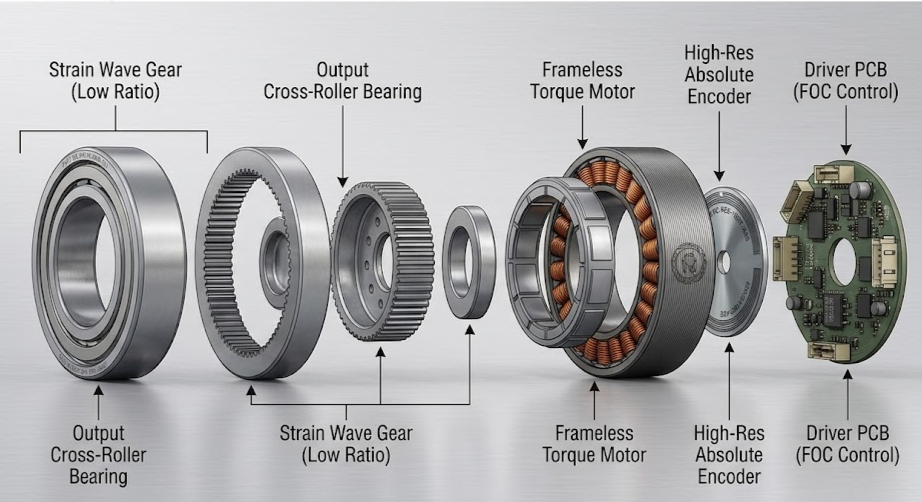
- Have a hollow center for cable and instrument lumen pass-through.
- Be frameless (no separate encoder housing).
- Have an outer diameter consistent with the joint housing.
4. Low Magnetic Signature
Some surgical procedures are performed under MRI guidance or other radiation types. The surgical robot must not introduce magnetic artifacts that would degrade the MRI image quality or distort the static magnetic field. Encoders with permanent magnets (magnetic encoders) are excluded from MRI-guided procedures.
Sterilization Compatibility
Surgical instruments that enter the sterile field may require sterilization. Depending on whether the encoder is inside or outside the sterile barrier:

Secure Your Components Stock Now with Torquety
Reliable automation components for high-performance applications.
Steam Autoclave Sterilization (134°C, 100% humidity, 30 minutes)
Autoclave conditions are hostile to most encoder technologies:
- Temperature: 134°C for 30-60 minutes, sustained thermal stress on all components.
- Humidity: 100% rH at pressure, water penetration through any imperfect seal.
- Pressure: 2–3 bar, may force water through seals that would otherwise survive ambient humidity.
Encoders expected to be autoclaved must:
- Be rated to 150°C minimum (with margin).
- Be hermetically sealed (not just IP67 — hermetic means no gas exchange at all).
- Use materials that withstand repeated autoclaving (300+ cycles).
Practical approach: Encoders are often located in the non-sterile zone of a surgical robot (proximal joints, inside the cart) rather than in the sterile instrument (distal joints). Drapes and sterile covers separate the robot arm from the sterile field. This eliminates the need to autoclave the joint encoders.
Alternative Sterilization Methods
For instrument components that are distal to the sterile barrier:
- Ethylene oxide (EO) gas sterilization: Chemical sterilization at ambient temperature (25°C) and low pressure. Most encoder materials are EO-compatible if not sealed against gas exchange. However, EO requires outgassing time after sterilization.
- Hydrogen peroxide plasma: Low-temperature, no moisture. Compatible with most electronics if the chamber can tolerate the H₂O₂ radical.
Technology Assessment for Surgical Robot Joints
Optical Encoders (Interferential, Glass Scale)
Advantages:
- Highest accuracy class, significant margin over surgical requirements.
- Optical sensing immune to MRI magnetic fields.
- Proven in high-reliability medical imaging equipment (CT gantry encoders).
Disadvantages:
- Fragile glass scale, mechanical shock risk in a surgical environment.
- Not easily sealed for autoclave sterilization.
- Minimum envelope may be larger than other technologies at very small bore sizes.
Capacitive Encoders (Electric Encoder)
Advantages:
- Immune to magnetic fields, compatible with MRI-guided procedures.
- No magnetic signature.
- Compact hollow-shaft ring form factor (13 mm OD minimum).
- Low profile (< 10 mm axial depth).
- Tolerant to localized contamination (holistic averaging).
- Programmable (zero-point adjustment, BIT diagnostics).
- High-temperature variant rated to +125°C.
Disadvantages:
- Maximum accuracy is less than interferential optical, but exceeds surgical requirements
- PCB substrate outgassing must be verified for MRI proximity
- Contamination may affect their performance depending of the type
Inductive Encoders
Advantages:
- Immune to contamination, no optical path.
- Very compact ring form factor
- IP67 sealed versions available.
- Immune to non-magnetic contamination.
Disadvantages:
- Accuracy less than capacitive, still meets most surgical requirements.
- PCB-trace coils may interact with MRI RF excitation pulses (eddy currents), requires evaluation per specific MRI scanner frequency.
Accuracy Requirements for Surgical Robot Joints
A surgical robot with 7 joints and 700-800 mm reach from the proximal joint to the instrument tip:
- End-effector position accuracy requirement: ±0.5 mm (clinically relevant accuracy).
- Equivalent joint angle accuracy (worst-case single joint): ±0.5 mm / 700 mm × (180°/π) = ±0.041°.
With a safety factor of 5× and 7 joints sharing the error budget:
- Per-joint accuracy budget: ±0.041° / (√7 × 5) ≈ ±0.003°
An inductive encoder at ±0.0053° is at the edge of this budget but meets it.
Need a Custom Component Solution?
Contact our engineering team to discuss your application requirements and get a custom quote.