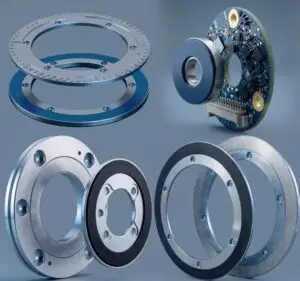
Encoders

Optical Encoder Performance in Harsh Environments: Contamination Failure Modes and Tolerant Designs

Optical encoder performance degrades when contaminants enter the sensing gap. The failure modes differ by contamination type: particulates obscure the scale progressively, while liquid mist can cause sudden signal loss. Contamination-tolerant optical architectures use wide-area averaging and signal processing to extend reliable operation in non-cleanroom environments.

Optical Encoder Performance in Harsh Environments: Contamination Failure Modes and Tolerant Designs Read More »

Multi-Turn Absolute Encoders: Architecture and Application in Multi-Revolution Actuation Systems

Multi-turn absolute encoders extend single-turn absolute position measurement across multiple revolutions, providing absolute angular position data for axes that may rotate more than 360°. Two principal implementation methods — gear reduction with additional encoder tracks, and revolution counting with non-volatile memory — offer different tradeoffs in complexity, power consumption, and resolution.

Multi-Turn Absolute Encoders: Architecture and Application in Multi-Revolution Actuation Systems Read More »

Servo Motor Velocity Control: Speed Feedback Methods and Velocity Estimation Techniques

Velocity control in servo systems is computed from position encoder data — differentiated over time, filtered, and fed back to the velocity regulator. The differentiation method, filter design, and feedback rate determine the achievable velocity bandwidth and low-speed smoothness. This article covers the four principal velocity estimation methods and their performance tradeoffs.

Servo Motor Velocity Control: Speed Feedback Methods and Velocity Estimation Techniques Read More »

Rotary Encoder Accuracy, Resolution, and Repeatability: Definitions and Measurement

Accuracy, resolution, and repeatability are three independent performance parameters of a rotary encoder. All three appear in datasheets, but they measure different things. Confusing them leads to incorrect encoder selection and missed specifications. This article defines each parameter with measurement context and explains how they interact in a complete position feedback system.

Rotary Encoder Accuracy, Resolution, and Repeatability: Definitions and Measurement Read More »

Electric Encoder Technology: Capacitive Absolute Position Sensing Principles

Electric encoder technology uses capacitive field modulation — rather than optical or magnetic principles — to measure absolute angular position. The holistic sensing approach measures the entire encoder area simultaneously, providing inherent immunity to localized contamination and relaxed installation tolerances without sacrificing accuracy.

Electric Encoder Technology: Capacitive Absolute Position Sensing Principles Read More »

Sensor Alignment for Small-Diameter Rotary Encoder Scales: Tolerance and Mounting Guidance

Optical encoder alignment tolerances for small-diameter rotary scales (≤ 20 mm) are significantly tighter than for linear scales or large-diameter rotary discs. This article defines the radial (Y-axis) tolerance reduction for small scales, explains the optical geometry responsible for the tighter requirement, and provides mounting design recommendations.

Sensor Alignment for Small-Diameter Rotary Encoder Scales: Tolerance and Mounting Guidance Read More »

Design Guidelines for Encoder Interface Cables: Specifications and Common Errors

Encoder interface cables carry differential position signals that are highly susceptible to noise, crosstalk, and impedance discontinuities. Correct cable selection — including characteristic impedance, conductor gauge, shielding type, and jacket material — determines whether the encoder achieves its specified noise immunity and signal quality at the required cable length.

Design Guidelines for Encoder Interface Cables: Specifications and Common Errors Read More »

Cable Shielding for Servo Encoder Systems: Grounding Practices and Ground Loop Mitigation

Cable shield termination and ground loop prevention are the most common sources of encoder signal noise in servo motor installations. This article defines the correct shielding method for motor and encoder cables, identifies the conditions that create ground loops, and describes practical mitigation techniques.

Cable Shielding for Servo Encoder Systems: Grounding Practices and Ground Loop Mitigation Read More »