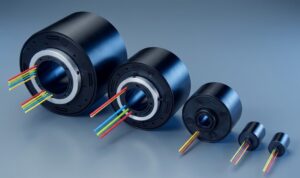
How to Get Servotecnica Slip Rings in the UK. A Guide to Rotary Power and Signal Transmission
Every rotating system that needs to transmit electrical power, data signals, Ethernet communications, or fluid media from a stationary structure […]
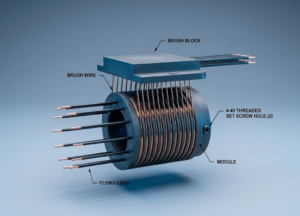
Carbon brush wear in slip rings is predictable and measurable. Replacement intervals depend on current density, rotational speed, and operating temperature. This article defines the indicators of brush wear, the maintenance procedure for carbon brush replacement, and preventive inspection schedules to prevent unplanned failures.
Slip Ring Maintenance: Carbon Brush Replacement Intervals and Service Procedures Read More »
At rotational speeds above 1,000 rpm, slip ring design constraints shift. Brush wear rate increases nonlinearly with speed, contact resistance variation rises, and centrifugal effects on brush holders become significant. High-speed applications require specific brush geometry, surface velocity limits, and contact force calibration — or contactless alternatives.
Remote weapon stations (RWS) require slip ring assemblies that transmit high-speed data, HD video, and weapon control signals continuously through 360° of rotation. The assembly must maintain signal integrity under MIL-standard shock, vibration, and extreme temperatures while supporting the sensor, control, and communications architecture of the weapon system.
Slip Ring Assemblies for Remote Weapon Stations: Data, Video, and 360° Operation Read More »
The trajectory of slip ring technology is driven by three concurrent demands: higher data bandwidth from modern sensors and imaging systems, the elimination of brush maintenance through contactless alternatives, and the integration of power, data, fluid, and position functions into unified rotating assemblies. This article defines the current state and near-term direction of each trend based on documented engineering capabilities.
RF rotary joints transmit microwave and millimeter-wave signals across a rotating interface. Their integration with electrical slip rings creates hybrid assemblies capable of simultaneously transmitting power, data, and RF signals — a requirement for modern radar and electronic warfare platforms.
Offshore wind turbine slip rings face a combined environment of saltwater corrosion, humidity cycling, and marine organisms that significantly accelerates degradation compared to onshore equivalents. Corrosion protection class C4/C5-M, IP65 minimum ingress protection, and seawater-resistant coatings are the baseline design requirements for offshore deployment.
Slip Ring Offshore Wind: Corrosion Protection, Ingress Rating, and Lifecycle Service Read More »
Real-time condition monitoring of slip ring assemblies converts measured operational data — contact resistance, temperature, vibration, humidity, and torque — into actionable maintenance alerts. Intelligent algorithms applied to this data predict remaining service life and reduce unplanned downtime in high-value rotating systems.
Offshore oil and gas platforms classify areas around hydrocarbon sources as hazardous zones. Electrical equipment installed in these zones must be certified to ATEX (in Europe) or IECEx (internationally) to prevent ignition of flammable gases. Slip rings in Zone 1 and Zone 2 environments require Ex-d (flameproof enclosure) or Ex-e (increased safety) certification, with additional requirements for marine corrosion protection.
Active-cooled radar transmitters, industrial machinery, and medical imaging systems require liquid coolant to flow through a rotating interface. Fluid rotary joints provide leak-free rotation while maintaining flow rates up to 1,600 l/min at pressures up to 12 bar. Integration with electrical slip rings in hybrid assemblies addresses the full transmission requirement of the rotating system.
Fluid Rotary Joints for Active-Cooled Rotating Systems: Design and Specifications Read More »