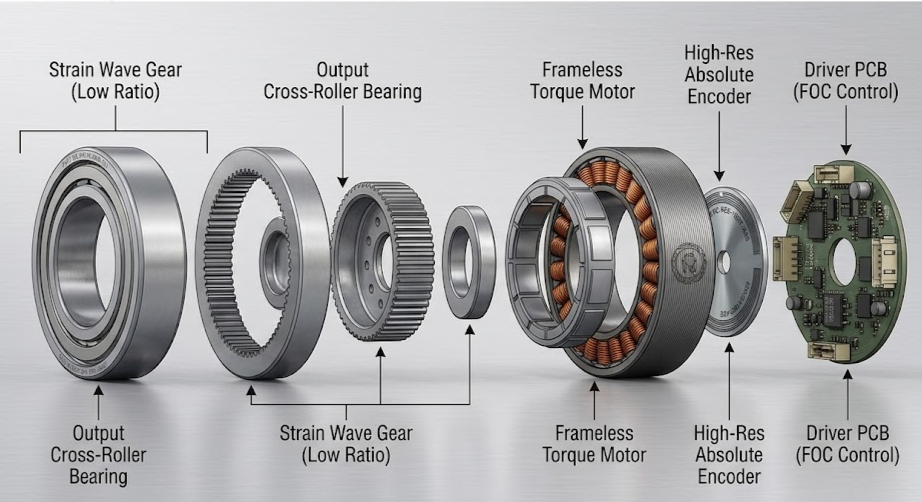

Exoskeletons and wearable robotic suits require joint actuators that closely match human anatomy without adding excess mass or axial bulk. Integrating high-torque frameless BLDC motors with strain wave or cycloidal gearing leaves minimal axial space for feedback sensors. Torquety’s range of FLUX IND-ROT ultra-flat inductive encoders resolves this engineering challenge, providing absolute position feedback in profiles as thin as 1.6 mm with an assembly weight starting at just 9 grams.
💡 Lead Editor’s Engineering Insight
Battery efficiency is paramount in untethered mobile exoskeletons. FLUX IND-ROT encoders utilize optimized high-frequency excitation circuits that draw minimal current while supplying instant absolute position upon system startup. Additionally, their software-defined virtual multi-turn position recovery automatically saves multi-turn data during power-off, removing the need for bulky backup battery packs.
The Mechanical Challenge of Exoskeleton Joint Actuators
Designing actuators for human joint drives—such as the hip, knee, or ankle—demands high torque density, a hollow-shaft layout for cable routing, and extreme lightweighting. Placing an encoder inside this tight envelope brings major engineering constraints:

Secure Your Components Stock Now with Torquety
Reliable automation components for high-performance applications.
- Axial Space Constraints: Traditional housed encoders (35mm to 60mm deep) add unacceptable thickness, forcing the joint to protrude laterally from the user’s limb.
- Distal Mass Impact: Extra weight on the limbs exponentially increases the metabolic energy required by the user to swing their legs or arms. Minimizing distal mass is a primary design objective.
- Electromagnetic Fields: High-torque frameless BLDC motors generate intense magnetic fields. Near-situated magnetic sensors suffer from signal distortion and hysteresis, requiring thick, heavy shielding.
- Mechanical Deflection & Impact: Normal walking, jumping, and load carriage subject the joints to severe structural deflection and ground-impact shock. Fragile optical glass discs run the risk of cracking, and bearing wear degrades precision over time.
Holistic 360° Scanning vs. Eccentricity & Deflection
Under heavy physical load, exoskeleton joints inevitably bend or experience microscopic runout (eccentricity). Conventional encoders using magnetic xMR, Hall-effect, or optical segment scanning look at only a single point or a small section of the scale. When the rotor shifts off-center relative to the stator, segment-scanning sensors experience a severe positioning error.
The angular eccentricity error (denoted as δ in arcseconds) for a one-point scanning system can be calculated using the following formula:
Where e represents the eccentricity (half of the radial runout) in micrometers, and D is the encoder diameter in millimeters.
FLUX encoders resolve this using a patented holistic 360° scanning principle. Rather than reading a single point, the stator coils scan the entire circumference of the rotor. This design naturally averages out eccentricity, runout, and axial deviations, both statically (during mounting) and dynamically (under physical deflection during operation).
Eccentricity Error Comparison (FLUX IND-ROT vs. One-Point Segment Scanning)
| Encoder Size (Outer Diameter D) | FLUX IND-ROT Error (e = 10 μm) | Conventional One-Point Error (e = 10 μm) | FLUX IND-ROT Error (e = 20 μm) | Conventional One-Point Error (e = 20 μm) |
|---|---|---|---|---|
| 55 mm | < ± 8″ | ± 75″ | < ± 16″ | ± 150″ |
| 69 mm | < ± 6″ | ± 60″ | < ± 12″ | ± 119″ |
| 80 mm | < ± 6″ | ± 52″ | < ± 12″ | ± 103″ |
| 96 mm | < ± 5″ | ± 43″ | < ± 10″ | ± 86″ |
“By scanning the entire 360-degree rotor scale, FLUX encoders inherently eliminate positioning errors caused by shaft eccentricity and dynamic structural loads—keeping position data stable where conventional systems fail.”
Physical Integration & Size Profiles
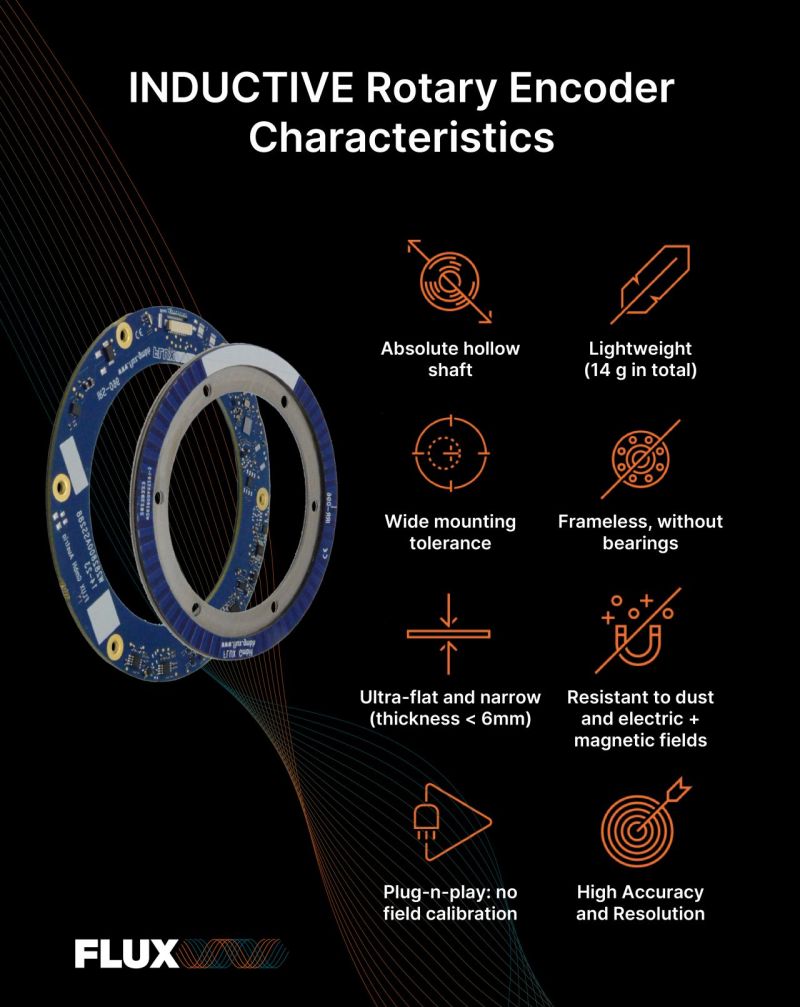
To match the anatomical scales of human joints, Torquety provides the FLUX IND-ROT technology in two tailored classes, offering a hollow-shaft, frameless, and open-PCB design:
- IND-ROT MINI Series (34mm, 36mm, 45mm Outer Diameter): Ideal for smaller joints like ankles, wrists, or compact robotic fingers.– Mass Budget: Stators weigh 3.5g (34mm), 4.0g (36mm), or 5.5g (45mm). Rotors weigh just 5.5g. Combined weight is only ~9.0g to 11.0g.– Clearance & Bore: Stator board base is 1.6mm thin. Component height clearance is 2.0mm across the board (3.60mm at the connector), making the entire stack-up under 6mm. Inner hollow-shaft diameter ranges from 9mm to 17mm.
– Specs: 18 to 19 bits output resolution (ENOB of 17 to 18 bits). Achievable accuracy down to ± 0.025°.
- IND-ROT Standard Series (55mm, 69mm, 80mm, 96mm Outer Diameter): Optimized for large, primary load-bearing joints like hips and knees.– Mass Budget: Stators weigh 7g to 12g. Rotors weigh 7g to 18g. Combined weight is only 14g to 30g.– Clearance & Bore: Large inner through-holes from 26mm up to 67mm for routing multi-core motor power lines, communication buses, or fluid lines. Stack-up thickness remains under 6mm (max 7.75mm to 10.40mm depending on mounting options).
– Specs: 21 to 22 bits output resolution (ENOB of 19 to 20 bits). Achievable standard accuracy down to ± 0.012° (± 45 arcseconds) for the 96mm model.
Electrical Specifications & Drive Connectivity
Mobile wearable robotics rely on battery power and immediate signal readiness. The FLUX IND-ROT series provides robust electrical interfaces that easily integrate into standard motion controller nodes:
- Input Supply: Mini series accepts 4.35 to 36 Vdc. Standard series operates on a 5V nominal option (4.35 to 6 Vdc) with reverse polarity protection.
- Low Power Consumption: Drawing a maximum of 100mA @ 5 Vdc or 30mA @ 24 Vdc (MINI), or 150mA @ 5 Vdc (Standard), minimizing thermal heat output inside sealed actuators.
- Low Latency & High Speed: Position update rate under 1 microsecond, supporting rotational speeds up to 6,000 RPM. Power up-time is a maximum of 0.8 seconds.
- Absolute & Incremental Output: Native support for BiSS-C (protocols BIS10, BIS21, BIS00), SSI (SSI00 to SSI04), SPI, and asynchronous UAT (UAT00, UAT01), as well as parallel incremental A/B/Z feedback.
- Environmental Ruggedness: Rated IP00 as an open PCB design, but naturally resistant to dust and moisture condensation. Features high vibration tolerance (20 g at 55..2000 Hz) and impact shock resistance (200 g at 6 ms, 1000 shocks), complying with EN IEC 61000-6-2 (EMC immunity).
Comprehensive Specification & Capability Matrix
| Actuator Parameter | Conventional Optical / Magnetic Encoders | Torquety / FLUX IND-ROT Ultra-Flat Series |
|---|---|---|
| Axial Thickness | 35mm to 60mm housed assembly | Ultra-flat < 6mm (1.6mm PCB base) |
| Weight Impact | 250g to 500g per joint drive | Lightweight 9g to 30g total (rotor + stator) |
| Hollow Shaft Bore | Solid shaft or very narrow hollow bore | Large through-hole up to 67mm |
| Eccentricity Tolerance | Poor; causes errors up to ±150 arcseconds | Holistic 360° scanning averages out errors |
| Magnetic Field Immunity | Suffer signal distortion near frameless BLDCs | Inherent inductive immunity (no shielding needed) |
| Impact Resistance | High risk of glass cracking & bearing damage | Frameless, bearingless design (200g shock) |
| Battery Efficiency | High power optical LEDs, high power draw | Low-power inductive excitation (max 100-150mA) |
| Startup Position Mode | Requires backup batteries or homing routines | Instant true absolute startup (virtual multi-turn) |
Selecting the Right Encoder for Your Application
Whether designing a next-generation surgical robot arm, an industrial load-bearing exoskeleton, or a high-torque frameless motor drive, the FLUX IND-ROT Ultra-Flat Series provides the mechanical flexibility, structural tolerance, and electrical reliability required for high-performance closed-loop control.
Need a Custom Component Solution?
Contact our engineering team to discuss your application requirements and get a custom quote.