
High-speed CNC milling machines, turning centers, and multi-axis rotary tables demand real-time position feedback to maintain tight part tolerances. However, continuous exposure to synthetic coolants, hot metallic swarf, and cutting oils frequently blinds traditional optical encoders, causing machine downtime and scrapped workpieces. To achieve reliable closed-loop control in harsh cutting environments, modern design engineers are turning to advanced, calibration-free inductive and Giant Magneto Impedance (GMI®) technologies.
💡 Lead Editor’s Engineering Insight
By leveraging non-contact electromagnetic and GMI principles, modern encoders bypass the physical limitations of optical scanning. They eliminate the need for costly, high-maintenance air-purge systems, while their holistic 360° scanning inherently cancels out assembly and runout errors that would otherwise compromise machine tool accuracy.
The Mechanical Reality of CNC Feedback Systems
When integrating feedback sensors into motion control systems, design engineers must balance positional resolution against real-world mechanical tolerances. Traditional optical glass scales require precise sub-micron alignment and sealed, pressurized housings to prevent failure from dust or liquid ingress. Conversely, standard magnetic encoders provide environmental ruggedness but can suffer from non-linearities, magnetic interference, and hysteresis. FLUX position encoders bridge this gap by merging optical-grade precision with magnetic-grade robustness.

Secure Your Components Stock Now with Torquety
Reliable automation components for high-performance applications.
Cancelling Eccentricity Errors with 360° Holistic Scanning
A primary limitation of traditional encoders (both optical and magnetic) is their reliance on segment or “one-point” scanning. If the rotor is slightly misaligned or suffers from radial runout under machining loads, it introduces a significant eccentricity error. The eccentricity error (δ) in arcseconds for a “one-point” scanning encoder can be calculated using the following formula:
Where e is the eccentricity (half of the runout) in µm, and D is the encoder diameter in mm. For example, a 96 mm rotary table experiencing 20 µm of runout (10 µm eccentricity) will suffer an additional ±43 arcseconds of error. If the runout reaches 40 µm, the error doubles to ±86 arcseconds.
FLUX encoders utilize a holistic 360° scanning principle, meaning the stator reads the entire circumference of the rotor simultaneously. By scanning 360 degrees, the sensor geometry inherently averages out eccentricity, runout, and alignment errors. The resulting accuracy improvement is dramatic:
- At 10 µm Eccentricity (20 µm Runout): A one-point encoder exhibits up to ±75” (55mm diameter) to ±43” (96mm diameter) of added error. Under the same conditions, the FLUX IND-ROT limits error to <±8”, while the high-precision FLUX GMI-ANG drops it to <±1”.
- At 20 µm Eccentricity (40 µm Runout): A one-point encoder exhibits up to ±150” (55mm) to ±86” (96mm) of added error. The FLUX IND-ROT limits error to <±16”, and the FLUX GMI-ANG maintains an exceptional <±2”.
FLUX Patented Technologies: GMI® vs. Inductive (IND)
Authoritatively backed by over 40 years of position feedback experience, Austria-based FLUX GmbH has developed two core technologies to satisfy distinct motion control design constraints:
1. Giant Magneto Impedance (GMI®) Technology
The patented FLUX GMI® technology utilizes the high-frequency skin effect in specialized materials whose AC impedance changes dramatically when exposed to external magnetic fields. GMI® encoders combine the high resolution of optical systems with the robustness of inductive systems. Operating completely free of hysteresis and with real-time position updates, GMI-ANG encoders deliver absolute resolutions up to 25-bit and standard accuracies down to ±4 arcseconds (improving to ±3 arcseconds under Grade G high-accuracy options).
2. High-Frequency Inductive (IND) Technology
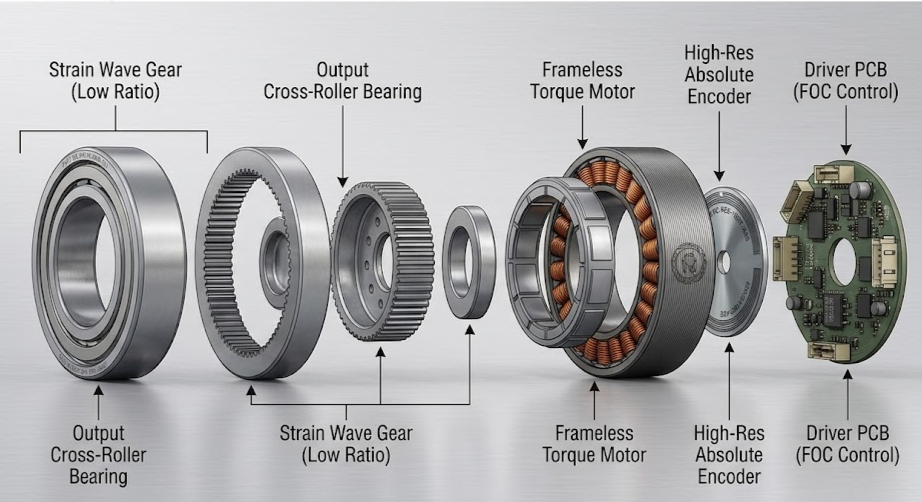
FLUX Inductive technology relies on high-frequency electromagnetic coupling between the stator’s absolute sensor track and the rotor’s absolute target ring. The primary advantage of IND technology is its complete immunity to stray magnetic and electrical interference, allowing it to be integrated directly inside permanent magnet synchronous motors (PMSM) or next to high-torque frameless motor coils.
The IND portfolio includes the ultra-lightweight and thin IND-ROT series (weighing just 14g, with a thickness of <6 mm in an open PCB configuration) and the ruggedized IND-MAX series, which features an encapsulated IP67/IP68 housing designed to operate reliably under extreme physical conditions.
Overcoming CNC Thermal Drift and Fluid Ingress
Thermally-Matched Materials (CTE)
Industrial machining tables experience significant temperature rises during long cutting cycles. Traditional optical glass scales have a low Coefficient of Thermal Expansion (CTE), creating a thermal expansion mismatch with the steel and aluminum castings of the machine tool. This mismatch causes physical stress and positional drift. FLUX encoders resolve this by using thermally-matched materials:
- GMI-ANGLE series encoders use stainless steel housings and carriers with a CTE of ~10 ppm/°C, matching steel machine spindles and rotary components perfectly.
- IND-MAX series encoders feature anodized aluminum bases with a CTE of ~24 ppm/°C (or optional electroless nickel finishing) which align with aluminum motor enclosures and structures.
- IND-ROT series stators are constructed on FR4 bases (CTE ~18 ppm/°C) paired with stainless steel rotors (CTE ~10 ppm/°C), providing mechanical durability across a wide temperature envelope.
Eliminating Air-Purge Sealing Systems
Optical scales require high-maintenance pressurized air lines to create a positive pressure barrier against oil, swarf, and coolant spray. If the air compressor fails or condensation develops in the lines, the encoder blinds immediately. The FLUX IND-MAX series is rated to IP67 (standard) and IP68 (Option W). Capable of resisting pressures from 0.05 to 7 bars (and up to 200 bars under Option H), these encoders operate while fully submerged in cutting fluids. This completely eliminates the need for air-purge lines, filters, and energy-intensive compressors, reducing machine complexity and operating costs.
“By combining the hysteresis-free precision of optical scanning with the physical robustness of electromagnetic induction, FLUX GMI and Inductive encoders remove the single most common failure point in modern CNC machines.”
Position Feedback Technology Comparison
| Parameter | Traditional Optical Encoder | FLUX Inductive (IND-ROT/MAX) | FLUX GMI® (GMI-ANG/ROT) |
|---|---|---|---|
| Operating Principle | Optical scanning of glass scale code disk | High-frequency electromagnetic coupling | AC impedance shifts via skin effect (GMI) |
| Standard Accuracy | ±1 to ±5 arcseconds | ±45 arcseconds (IND-ROT) ±10 to ±18 arcseconds (IND-MAX) | ±4 to ±7 arcseconds (High accuracy option to ±3″) |
| Maximum Resolution | Up to 24-bit | Up to 22-bit (IND-ROT) Up to 23-bit (IND-MAX) | Up to 25-bit |
| Hysteresis | None | None (Hysteresis-free) | None (Hysteresis-free) |
| Eccentricity Error | High error (one-point segment scanning) | Inherent cancellation via 360° scanning | Inherent cancellation via 360° scanning |
| Coolant & Swarf Immunity | Poor. Requires physical seals & air purge | Excellent. 100% immune (IP67/IP68) | Excellent. 100% immune (IP67) |
| Thermal Drift Mismatch | High (glass scale expansion mismatch) | Low (aluminum/PCB bases match machines) | Negligible (stainless steel base matches spindles) |
| Field Calibration | Required upon install / post-maintenance | Plug-and-Play (no calibration required) | Plug-and-Play (no calibration required) |
| Maximum Speed | Limited by optical scanning limits | Up to 6,000 RPM (higher on request) | Up to 2,000 RPM (higher on request) |
Selecting the Right Encoder for Your Machine Design
Choosing between FLUX technologies depends on your machine layout and target tolerances. For the high-precision rotary tables and multi-axis axes that perform demanding machining, the GMI-ANGLE series offers near-optical accuracy with magnetic-level mounting tolerances. For dynamic spindle motor feedback and cramped axis positions, the ultra-slim IND-ROT series PCB kit integrates directly without added mechanical weight. For heavy-duty turning and grinding environments exposed to direct chips and coolant washdowns, the fully encapsulated IND-MAX series provides robust protection.
Need a Custom Component Solution?
Contact our engineering team to discuss your application requirements and get a custom quote.