In industrial automation and rotary machinery design, the slip ring is often treated as a standard catalog component to be specified near the end of the engineering cycle. However, deferring slip ring selection until CAD models are finalized frequently leads to spatial constraints, electromagnetic interference (EMI) issues, and expensive late-stage redesigns.
By engaging application engineers early in the conceptual design phase, OEM machine builders can optimize rotational performance, guarantee long-term signal integrity, and minimize total cost of ownership (TCO).
💡 Key Takeaway
Integrating rotary slip rings during the preliminary 3D layout phase eliminates structural retrofitting, allows seamless cable routing, and prevents high-frequency crosstalk between power lines and Industrial Ethernet protocols.
The Hidden Costs of Late-Stage Slip Ring Retrofitting
When mechanical envelopes are fixed before selecting a slip ring, engineers are forced to compromise on electrical specifications or select custom sub-optimal footprints. The most common technical challenges include:

Secure Your Components Stock Now with Torquety
Reliable automation components for high-performance applications.
- Envelope Constraints: Standard off-the-shelf slip rings may not fit the internal bore diameter or mounting flange spacing.
- Thermal Dissipation Bottlenecks: High-current power channels generate heat that must be dissipated away from sensitive digital encoders or optical fiber channels.
- Cable Stress & Bending Radii: Inadequate space for wire exits forces tight cable bends, leading to premature conductor fatigue.
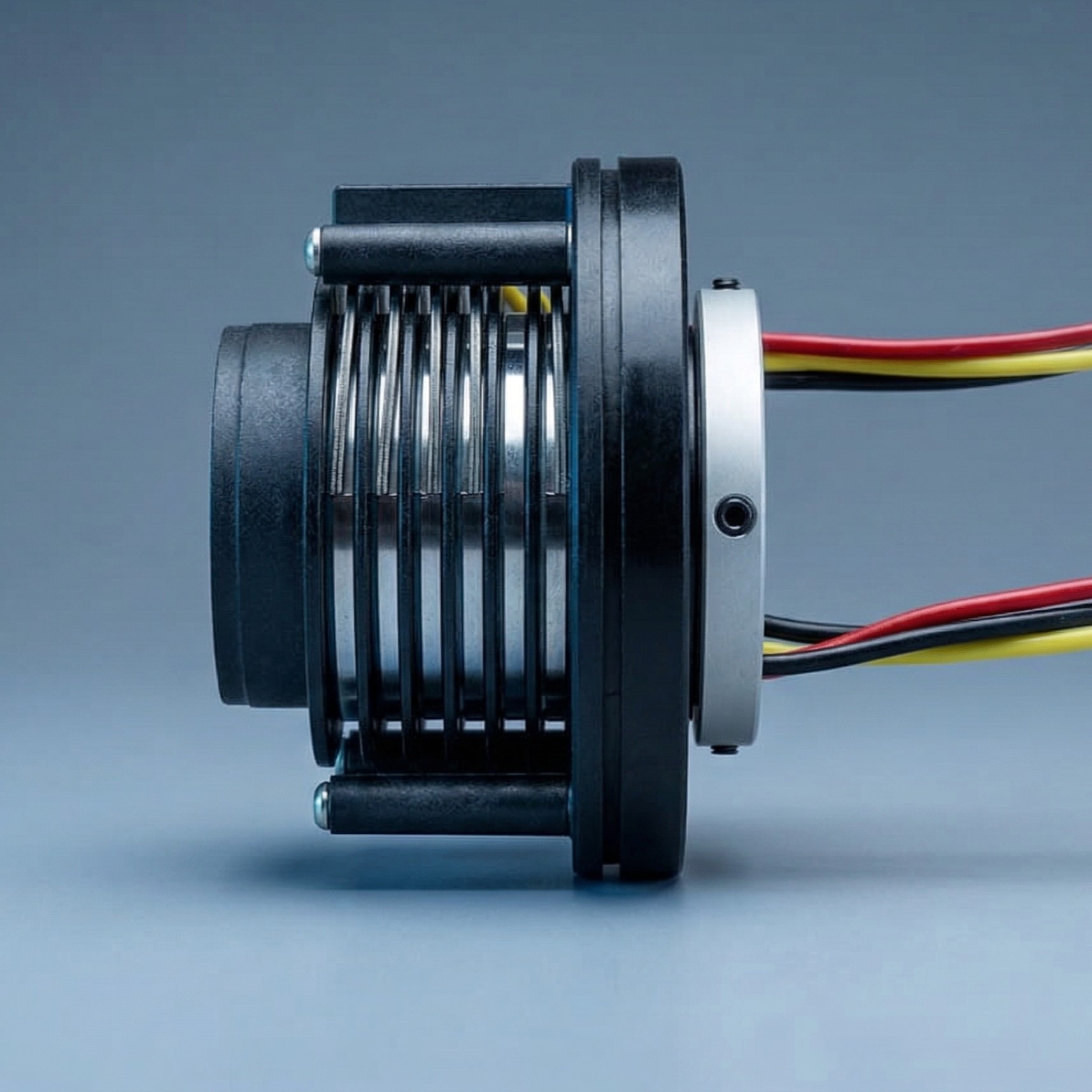
Critical Parameters to Define Early in the CAD Phase
To ensure a seamless design integration, engineering teams should evaluate four primary functional parameters during the preliminary specification stage:
| Design Parameter | Engineering Impact | Torquety Recommended Approach |
|---|---|---|
| Bore Architecture | Determines whether fluid/air lines or central shafts pass through the rotary joint. | Specify Through-Bore (C-Series) when central mechanical clearance is required. |
| Signal Integrity | High-speed data (Profinet, EtherCAT) susceptible to EMI from power channels. | Utilize shielded twisted pairs and gold-on-gold contact geometry. |
| Environmental IP Rating | Exposure to dust, washdown fluids, or extreme temperatures. | Select IP65/IP68 sealed enclosures for food, pharmaceutical, or marine applications. |
“A slip ring is not just a connector; it is a precision electro-mechanical rotary interface. Designing around it rather than cramming it in guarantees long-term operational uptime.”
Partnering with Torquety for Co-Engineered Solutions
At Torquety, our application engineering team collaborates directly with OEM machinery designers from initial concept to volume production. By reviewing your 3D CAD models, electrical schematics, and duty cycles early in development, we deliver custom or tailored slip ring assemblies that fit your exact mechanical envelope while maximizing rotational lifespan.
Need a Custom Component Solution?
Contact our engineering team to discuss your application requirements and get a custom quote.