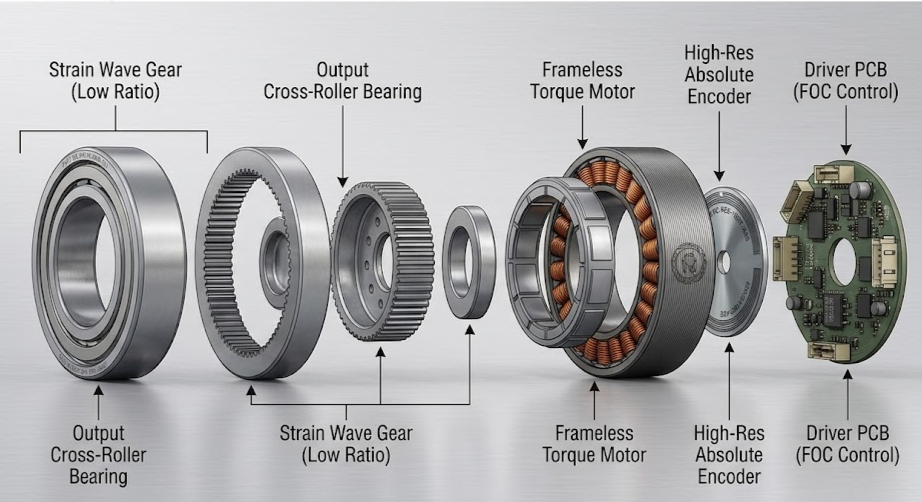
Executive Summary
Rotary encoders are electromechanical devices that provide feedback on the rotational movement of a shaft or axle. They consist of two core elements — a reader (sensor) and a scale — and operate through one of two encoding paradigms: incremental or absolute. The choice between these two paradigms is not a matter of preference; it is dictated by the failure modes, homing requirements, and operational continuity constraints of the target application.
How Incremental and Absolute Encoders Encode Position
Incremental Encoding
Incremental rotary encoders employ optical scanning of a rotary scale. The scale carries reflective and non-reflective lines of precisely equal width arranged in a repeating pattern. As the scale moves relative to the sensor, the lines are counted to produce position change information.
The interface to an incremental encoder is designated ABZ:
- A and B are square waves, phase-shifted by 90°. The lead/lag relationship between A and B indicates direction of motion.
- Z (index) is a single pulse per revolution that marks the zero reference position.
Because incremental encoders record only changes in position — not absolute angle — they require a homing routine at startup. The system must physically move to locate the Z index pulse before any valid absolute position can be established. Loss of power means loss of position; the homing cycle must be repeated.
Absolute Encoding
Absolute rotary encoders retain position across power cycles. In addition to an incremental track, they incorporate a pseudo-random pattern of reflective lines illuminated and projected to a second sensor. This creates an angular barcode that, at startup, identifies the precise line on the incremental track — providing absolute angular position immediately, without motion.
For example: on power-up, the system reads the pseudo-random pattern and determines it is at line 128, corresponding to exactly 43.5°. No homing movement is required.
The interface is typically a synchronous serial protocol. The open standard BiSS-C is widely used for high-speed absolute encoders, as are SSI and SPI. Many absolute encoders also provide an incremental ABZ output with configurable resolution for legacy compatibility.

Secure Your Components Stock Now with Torquety
Reliable automation components for high-performance applications.
Key Technical Parameters That Distinguish Both Types
| Parameter | Incremental | Absolute |
|---|---|---|
| Position retention after power loss | No | Yes |
| Homing cycle required | Yes | No |
| Interface | ABZ (quadrature) | BiSS-C, SSI, SPI |
| Typical resolution | Up to 22-bit equivalent via interpolation | 18–26 bit native |
| Scale complexity | Single periodic track | Incremental + pseudo-random track |
| Startup latency | High (homing required) | None |
| Applicable accuracy (interferential optical) | ±2 arc-seconds | ±0.005° to ±0.01° |
For applications where the axis can be safely homed at each startup — and where positional accuracy between power cycles is irrelevant — incremental encoders are simpler and often lower cost. For axes where homing is hazardous, mechanically constrained, or time-prohibitive (e.g., robotic joints, surgical systems, multi-turn actuators), absolute encoders are the only operationally viable choice.
Operational Impact, Edge Cases, and Integration Considerations
When Incremental Fails in Practice
The primary operational risk with incremental encoders is index pulse dependency. If the homing routine is interrupted — by an E-stop, mechanical obstruction, or power fault — the system enters an undefined state. In multi-axis robots, this means all axes must re-home before any motion can resume, which introduces latency and mechanical wear on limit switches and hard stops.
Additionally, incremental encoders are vulnerable to quadrature count loss under high electrical noise conditions. If a transition is missed on the A or B channel, the position accumulator drifts without self-correction.
Absolute Encoder Integration Constraints
Absolute encoders using serial protocols introduce communication latency that incremental ABZ does not. BiSS-C and SSI are synchronous; the controller must initiate a read cycle and wait for the encoder to serialize and transmit the position word. At 10 MHz clock, a 26-bit word requires approximately 2.6 µs per read. For high-bandwidth velocity loops, this latency must be accounted for in the control law.
Many absolute encoders expose both interfaces simultaneously: a high-speed serial output for absolute position, and a parallel ABZ output for incremental speed feedback. This hybrid approach allows the absolute position to establish reference at startup while the ABZ tracks incremental motion at full loop bandwidth.
Eccentricity and Modular Installation
For modular encoder systems (scale + separate readhead), concentric mounting of the scale is critical. The angular error introduced by eccentricity follows:
Angular error = arctan(eccentricity / radius)
For small-diameter scales, this error is amplified. At 12 mm diameter, an eccentricity of 200 µm produces a significantly larger angular error than the same eccentricity on a 100 mm scale. High-performance installations target eccentricity below 25 µm. In cases where this is mechanically impractical, two readheads positioned 180° apart can average out the eccentricity error.
Read more on this topic by exploring RF Rotary Joints: Frequency Range, Loss Specifications, and Integration with Slip Ring Assemblies, checking out our guide on Slip Ring Offshore Wind: Corrosion Protection, Ingress Rating, and Lifecycle Service, or reviewing Rotary Encoders for SATCOM Antenna Pointing Systems: Requirements and Technology Selection.
Source Your Encoder from Torquety — Official UK Distributor
Torquety distributes and supplies Rotary Encoders from our London headquarters, providing engineers across the UK with fast access to verified, in-stock components. We stock Encoder units ready for next-day dispatch from UK stock — no long international lead times. Whether you need one unit or a volume order, Torquety delivers the exact specification your application demands.
Source Your Encoder from Torquety — Official UK Distributor
Torquety distributes and supplies Rotary Encoders from our London headquarters, providing engineers across the UK with fast access to verified, in-stock components. We stock Encoder units ready for next-day dispatch from UK stock — no long international lead times. Whether you need one unit or a volume order, Torquety delivers the exact specification your application demands.
Need a Custom Component Solution?
Contact our engineering team to discuss your application requirements and get a custom quote.