Security matrices and surveillance frameworks rely on automated multi-axis gimbals and Pan-Tilt-Zoom (PTZ) dome cameras that demand a full 360-degree field of view. Hard-wired connections severely restrict panning mechanisms, causing high mechanical strain and eventual cable failure under constant oscillation.
To eliminate these critical blind spots, mechatronic systems integrate slip rings for camera systems. Serving as a continuous stationary-to-rotary bridge, these components pass telemetry, power, and high-frequency data from a fixed mount to the endlessly spinning camera head without dropping frames or inducing signal jitter.

The Spatial and Geometric Form Factors of Camera Slip Rings
Integrating rotary joints into compact hulls like ceiling domes, drone antennas, or tracking optics requires strict adherence to tight spatial and weight footprints.
System architects select between two primary configurations based on the camera mount’s mechanical architecture:
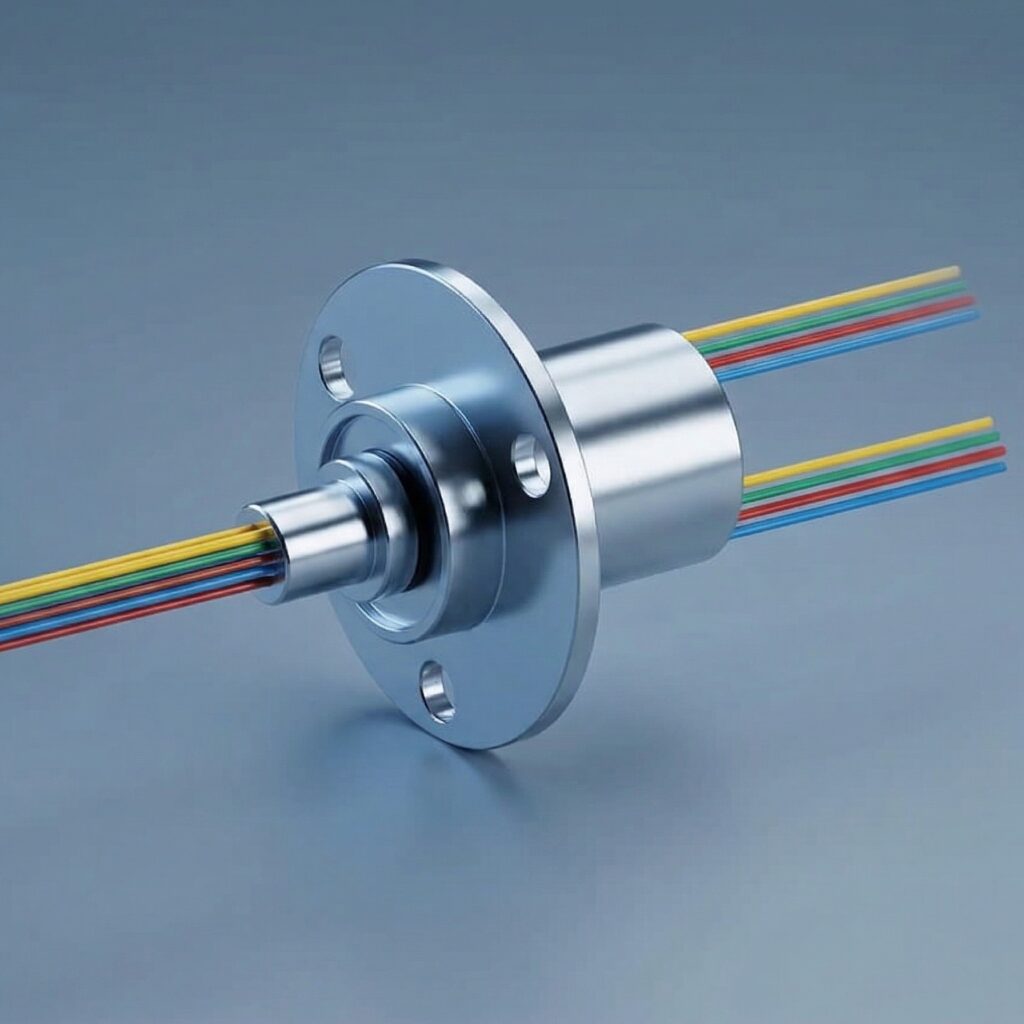
- Capsule Slip Rings: These enclosed designs feature vastly minimized outer diameters (typically ranging between 12.4mm and 25mm) and a highly reduced total payload weight (20g to 150g). This lightweight construction directly cuts peripheral sliding speeds, curbing material wear and lowering the torque requirements for smaller pan-tilt motors.
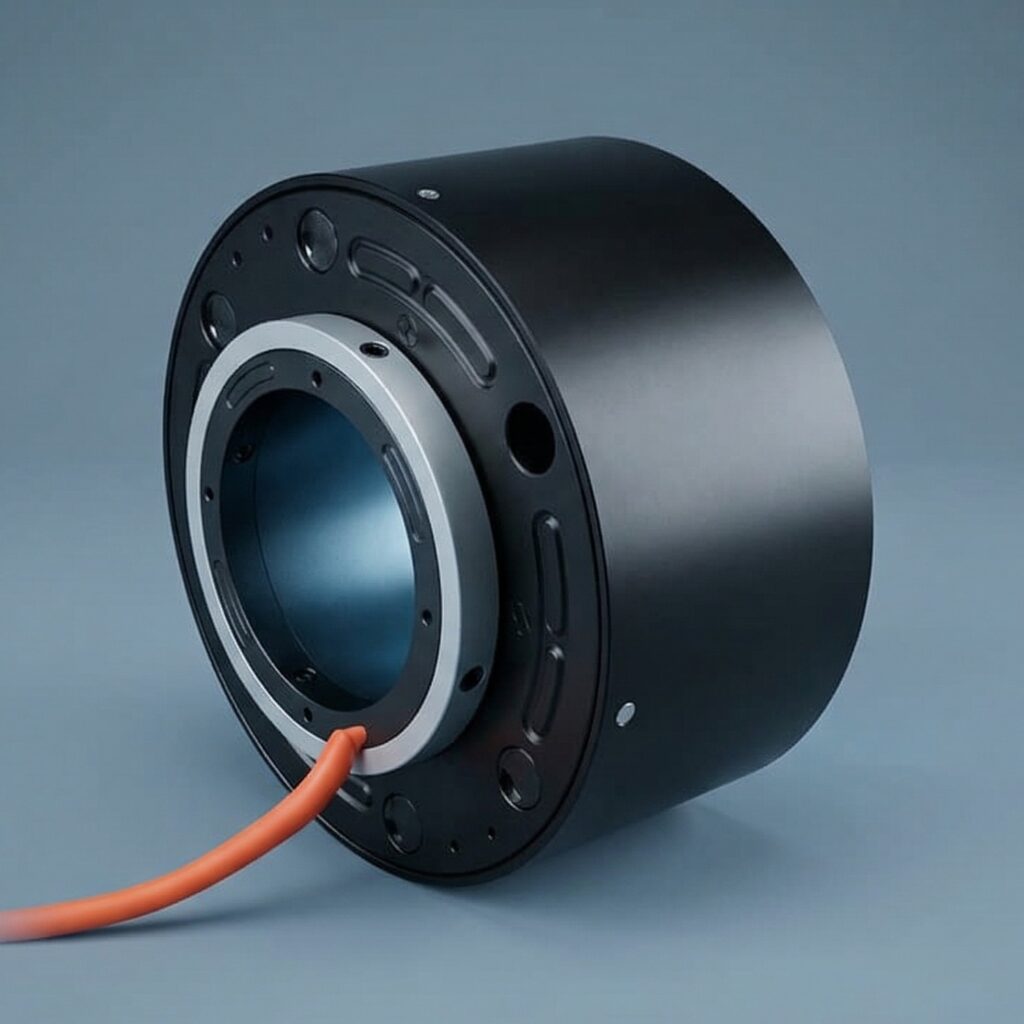
- Through-Bore Slip Rings: Featuring a centralized hollow passage (bore diameters from 3mm up to 100mm), these shafts allow engineers to route mechanical plumbing, drive shafts, or central fluidic piping directly through the spinning axis of rotation.
Transmission Protocols and Signal Integrity Metrics
High-definition video tracking configurations require extreme visual clarity for automated analytics and facial recognition. Consequently, slip rings for camera systems must handle high-bandwidth transmission profiles alongside low-voltage control loops and distinct power paths.

Secure Your Components Stock Now with Torquety
Reliable automation components for high-performance applications.
Standard capsule networks easily scale from 3 to 56 circuits to route power, CANopen, EtherCAT, and industrial Ethernet. However, uncompressed high-definition video lines (such as 1080i/HD-SDI or 1080p/3G-SDI streams) require specialized radio frequency (RF) capsule slip rings.
These variants integrate high-frequency coaxial lines capable of running up to 3 GHz and interface directly with standardized RF coaxial lines (including the RG174, RG316, and RG178 series) to eliminate zero-decay signal dropouts.
Metallurgical Optimization and Environmental Ruggedization
Surveillance infrastructure operates in demanding outdoor and tactical environments—ranging from sub-zero conditions to high-temperature maritime or desert deployments. Maintaining signal optimization requires specific environmental shielding and tribological selections:
| Technical Parameter | Engineering Specification / Selection | Operational Impact |
| Contact Metallurgy | Gold-on-gold brush and ring paths | Minimizes dynamic contact resistance (< 10 mΩ), suppressing electrical noise and signal jitter. |
| Ingress Protection | Upgraded IP65 water-resistant enclosures | Completely blocks dust particles and low-pressure water streams from entering the hull in outdoor deployments. |
| Thermal Thresholds | Certified standard range from -20°C to +80°C; extended range down to -40°C | Prevents micro-corrosion from humidity and survives radical environmental field shifts. |
| Mechanical Lifetime | Miniature high-precision stainless steel ball bearings | Achieves a maintenance-free expected lifetime of 3 × 10⁶ to 10⁷ continuous revolutions. |
Source Your Slip Ring from Torquety — Official UK Distributor
Torquety distributes and supplies Mechatronic Components from our London headquarters, providing engineers across the UK with fast access to verified, in-stock components. We stock Slip Ring units ready for next-day dispatch from UK stock — no long international lead times. Whether you need one unit or a volume order, Torquety delivers the exact specification your application demands.
Source Your Slip Ring from Torquety — Official UK Distributor
Torquety distributes and supplies Mechatronic Components from our London headquarters, providing engineers across the UK with fast access to verified, in-stock components. We stock Slip Ring units ready for next-day dispatch from UK stock — no long international lead times. Whether you need one unit or a volume order, Torquety delivers the exact specification your application demands.
Source Your Slip Ring from Torquety — Official UK Distributor
Torquety distributes and supplies Mechatronic Components from our London headquarters, providing engineers across the UK with fast access to verified, in-stock components. We stock Slip Ring units ready for next-day dispatch from UK stock — no long international lead times. Whether you need one unit or a volume order, Torquety delivers the exact specification your application demands.
Need a Custom Component Solution?
Contact our engineering team to discuss your application requirements and get a custom quote.