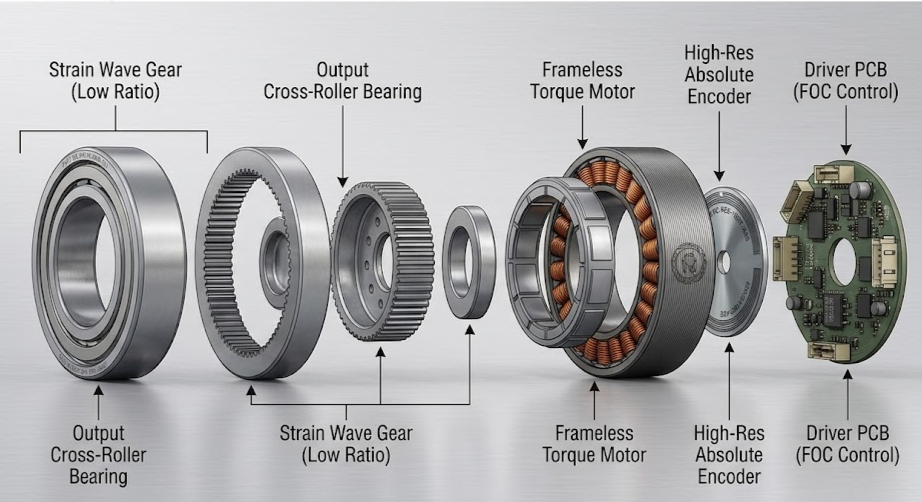
Robotic joints impose a unique combination of encoder requirements that differs from both general industrial and machine tool applications.
The encoder must fit within the joint’s limited axial depth, provide absolute position without homing, survive the thermal environment created by adjacent drives and motors, tolerate residual contamination from lubricants, and deliver position data with the repeatability needed for sub-millimeter end-effector positioning.
No single technology satisfies all these requirements without tradeoffs. Understanding which tradeoffs are acceptable for a given robot class determines the correct encoder technology.
Why Robot Joints Require Absolute Encoders
Industrial robots cannot perform a homing routine safely in most operating environments:
- A 6-axis arm stores joint positions as the reference for all calculated trajectories. At power-up without absolute position, all six joints must move to their home positions before operation can begin.
- Homing motion can sweep through the robot’s workspace, where other equipment or people may be present.
- On palletizing robots, the arm may be loaded at power-down and cannot home without first unloading.
- Collaborative robots (cobots) operating near humans cannot be permitted to make unpredictable homing moves.
Absolute encoders provide joint position immediately on power-up. The robot control system reads all joint angles, verifies the configuration, and proceeds from the actual position, without motion.
Multi-Turn Absolute Encoders
For revolute joints that may rotate through more than 360° (e.g., the wrist joints of a 6-axis arm can rotate multiple full turns), a multi-turn absolute encoder tracks position through multiple revolutions using a secondary counting mechanism. The multi-turn capacitive encoder tracks up to 4,096 full turns while maintaining single-turn resolution.
Form Factor Requirements for Robot Joint Integration
A robot joint is an inherently compact mechanical structure. The encoder must occupy minimal axial depth, have a hollow center to allow cable routing, and mount concentrically on the actuator output shaft.
Critical form factor parameters:
| Parameter | Requirement |
|---|---|
| Outer diameter | Must fit inside the joint housing |
| Inner bore | Must accommodate cable pass-through |
| Axial depth | As low as possible — often 5–15 mm |
| Frame-less construction | Preferred — no separate encoder housing |
| Mounting interface | Rotor mounts to shaft; stator mounts to housing |
Optical disk encoders (with housing): Typically 20–40 mm axial depth. The encoder housing adds to the length of the joint actuator stack.

Secure Your Components Stock Now with Torquety
Reliable automation components for high-performance applications.
Ring encoders (frame-less, hollow): Axial depth ≤ 10 mm for capacitive designs; 3–5 mm for inductive designs. Rotor and stator are individual components that mount directly to the actuator elements. The hollow center can be very large relative to the outer diameter (high ID/OD ratio).
For a compact robot joint with a 60 mm output shaft diameter and 12 mm available axial depth, a frame-less ring encoder is the only viable option. A standard packaged encoder cannot fit.
Thermal Considerations
In a sealed robot joint, the servo drive, brake, and motor generate heat that elevates the local temperature above ambient. Sustained temperature rises of 30–60°C above ambient are common at the encoder mounting location.
Technology sensitivity to temperature:
- Magnetic encoders: Accuracy degrades with temperature due to magnet strength variation. Rare-earth magnets degrade at elevated temperatures; SmCo maintains magnetic properties to higher temperatures but at higher cost.
- Optical encoders: Glass scales are stable across temperature; metal tape scales expand more. The dominant concern is the CTE mismatch between the glass disc and the metal hub.
- Capacitive (Electric Encoder): The electrode pattern on PCB substrate has a CTE of approximately 14–17 ppm/°C. At 30°C above ambient, positional drift from thermal expansion is typically smaller than the encoder’s absolute accuracy specification.
- Inductive encoders: PCB-trace coil geometry changes with temperature. Calibrated inductive encoders compensate for this in firmware. Uncalibrated designs show more temperature sensitivity than capacitive designs.
For high-duty-cycle robots with sustained thermal loading, optical glass-scale encoders provide the best thermal stability. Capacitive encoders offer comparable performance with better contamination immunity.
Contamination Management in Robot Joints
Robot joints use grease for bearing lubrication. Over years of operation, grease can migrate toward the encoder sensing gap through bearing clearances. Optical encoders are vulnerable to grease contamination of the scale surface.
Contamination mitigation by technology:
- Optical: Contamination-tolerant designs (wide-area averaging, signal processing that corrects for partial obscuration) extend service life but cannot operate with the optical path fully blocked.
- Inductive: Immune to non-conductive contamination. Grease in the sensing gap has no effect on electromagnetic coupling.
- Capacitive (Electric Encoder): Immune to non-conductive contamination. The capacitive measurement integrates across the full disc area, so localized contamination produces a fractional error that is averaged out.
For joints operating in environments with grease migration, oil mist (from pneumatic systems), or condensation, inductive or capacitive encoders provide substantially lower failure rates than optical designs.
Resolution and Accuracy Requirements for Robot Applications
Collaborative Robots (Cobots) and Light Industrial Arms
- Typical payload: 3–20 kg.
- Required end-effector accuracy: ±0.5–1 mm.
- Required joint accuracy: depends on arm geometry; typically 0.01°–0.05° per joint.
- Required resolution: 18–24 bit (approximately 0.001°–0.0001° per count).
For a 1 m arm with 6 axes, 0.01° joint accuracy translates to approximately ±0.17 mm end-effector position — within the target specification. For longer arms, tighter joint accuracy is required.
High-Precision Industrial Robots (SCARA, Delta)
- Required end-effector accuracy: ±0.01 mm or better.
- Required joint accuracy: < 0.005°.
- Required resolution: 24–26 bit.
At this level, the encoder’s accuracy specification begins to approach the limit of what is achievable with any absolute encoder technology. Interferential optical encoders with ±2 arc-second (±0.00056°) accuracy meet this requirement; capacitive encoders with ±0.001° (±3.6 arc-seconds) accuracy are also viable.
Interface Protocol Selection for Robotics
The encoder’s digital output protocol must be supported by the robot’s servo drive or controller:
- BiSS-C: Open standard; widely supported in servo drives for robotics; synchronous clocked; 10 MHz typical clock → 26-bit word in 2.6 µs per read.
- SSI: Older synchronous protocol; lower data rate than BiSS-C.
- EnDat 2.2: Proprietary but widely used in servo drive ecosystems.
- SPI: Simple, fast; requires proximity (short cable) due to SPI’s single-ended nature.
- Analog sin/cos: Highest speed interpolation; requires interpolation electronics at the controller.
For robots requiring functional safety (SIL2/PLd or SIL3/PLe), the encoder must communicate via a safety-rated protocol (e.g., BiSS Safety, HIPERFACE DSL Safety, FSoE).
For further reading, we highly recommend checking out RF Rotary Joints: Frequency Range, Loss Specifications, and Integration with Slip Ring Assemblies, as well as our articles on Incremental vs. Absolute Rotary Encoders: Technical Differences and Selection Criteria and Rotary Encoders for SATCOM Antenna Pointing Systems: Requirements and Technology Selection.
Need a Custom Component Solution?
Contact our engineering team to discuss your application requirements and get a custom quote.