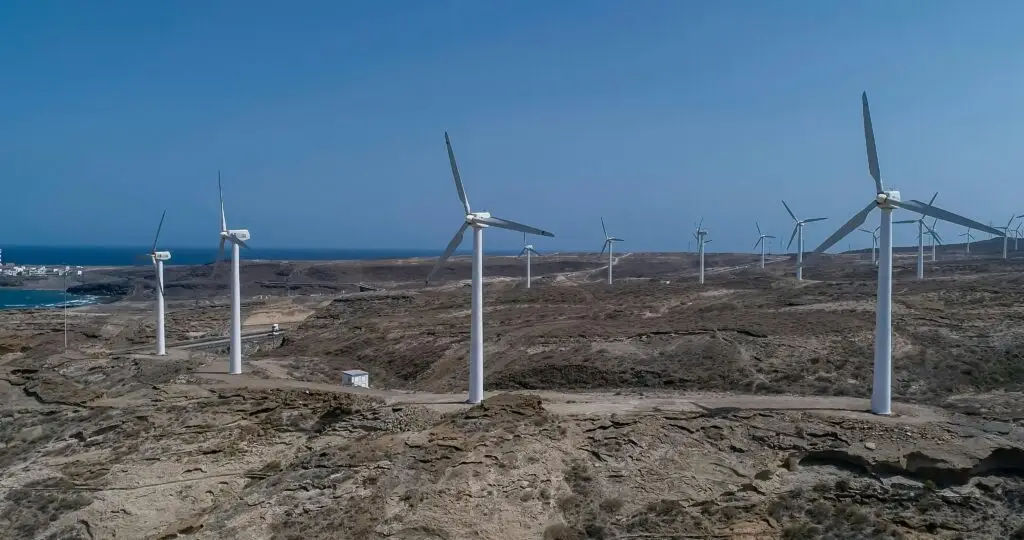
The offshore wind environment combines the mechanical demands of pitch control with an atmospheric corrosion rate that is 5–10 times higher than inland industrial environments.
Slip rings for offshore wind turbines must address corrosion protection, ingress protection, marine coating, and service accessibility, with maintenance access constrained by sea state, weather windows, and offshore vessel availability.
The engineering approach to offshore slip ring deployment differs from onshore installations not just in materials, but in the entire service model.
The Offshore Corrosion Environment
Salt-laden air, seawater spray at nacelle height (particularly in the North Sea and other exposed offshore regions), and temperature cycling from sea surface air create one of the most aggressive atmospheric corrosion environments experienced by industrial equipment.
ISO 9223 / ISO 12944 corrosion categories:
| Category | Environment | Corrosion Rate (Steel) |
|---|---|---|
| C1 | Indoor, dry | < 0.7 µm/year |
| C2 | Low: rural, unheated buildings | 0.7–5 µm/year |
| C3 | Medium: urban, coastal moderate | 5–15 µm/year |
| C4 | High: industrial, moderate salt | 15–50 µm/year |
| C5-M | Very high: offshore, marine | 50–80 µm/year |
Offshore wind slip ring design baseline: C4 corrosion protection minimum for all components in the nacelle; C5-M for external surfaces and cable entries exposed to direct salt spray.
Without C4/C5-M rated protection, standard industrial carbon steel enclosures develop surface corrosion visible within 6–12 months of offshore deployment, with structural corrosion affecting fastener integrity within 3–5 years.
Corrosion Protection Materials and Coatings
Housing Materials
For offshore slip ring housings, the material selection must balance corrosion resistance, weight, and machinability:
- Cast aluminum alloy: Standard option for most onshore and sheltered offshore installations. Requires surface treatment (anodizing + sealer, or powder coating with primer) to achieve C4 corrosion protection. Permanent-mold cast aluminum provides high quantities of consistent-geometry housings.
- Marine-grade aluminum: Higher alloy content for better seawater resistance. Anodized and sealed for C5-M.
- Stainless steel: Used for critical hardware in direct seawater contact, fasteners, cable entry glands, and secondary enclosures in splash zones. Higher cost and weight than aluminum.
- Sand-cast aluminum: Used for individual or low-quantity custom housing designs where tooling cost for permanent-mold casting is not justified.
Seawater-resistant paintwork: All external surfaces receive a marine coating system, typically primer + intermediate coat + topcoat, with total dry film thickness of 200–300 µm. Marine coating systems are qualified to ISO 12944-6 for C5-M environments.

Secure Your Components Stock Now with Torquety
Reliable automation components for high-performance applications.
Connector and Cable Entry Protection
The cable entry glands are the most common failure point for offshore slip ring housings. Ingress through imperfect cable glands allows humid salt air to enter the enclosure during thermal cycling:
- IP67 or higher cable glands: Required for offshore. IP67 means protection against temporary immersion to 1 m.
- EMC cable glands: In addition to sealing, EMC-rated glands maintain the cable shield continuity at the enclosure entry point — preventing RF ingress from the turbine’s converter electronics.
- Multi-cable sealing: When multiple signal cables enter through a single penetration, multi-cable sealing blocks prevent selective wicking of moisture along individual cable jackets.
Ingress Protection Rating Requirements
The IP (Ingress Protection) rating of the slip ring housing is specified by IEC 60529. For offshore wind:
| Component | Minimum IP Rating | Reason |
|---|---|---|
| Slip ring body | IP65 | Dust-tight + water jet protection (nacelle environment with humidity and condensation) |
| Cable glands | IP67 | Immersion protection during maintenance in rain |
| Connectors (unmated) | IP67 or higher | Temporary exposure during cable disconnection |
| Encoder electronics | IP65 | Dust and moisture protection within the hub |
IP65 vs. IP67 rationale: The nacelle interior does not typically experience immersion, but condensation, humidity cycling (daily temperature swing from 5°C overnight to 25°C midday over the ocean), and pressure-driven breathing of imperfect seals make IP67 the preferred rating for connectors that are regularly mated and unmated.
Operational Speed and Environmental Range for Offshore Slip Rings
Offshore pitch control slip rings combine the standard operating parameters with additional requirements:
| Parameter | Offshore Specification |
|---|---|
| Temperature range | -40°C to +70°C (same as onshore) |
| Humidity | 0–100% rH (offshore can reach 100% during fog/condensation) |
| Corrosion protection | C5-M (external); C4 (internal) |
| Ingress protection | IP65 minimum |
| Cable entry glands | IP67 EMC-rated |
| Rotational speed | 0–30 rpm (pitch control) |
| Shock/vibration | Up to 5 g (wave-induced platform motion + blade passing) |
| Altitude | 0–100 m (turbine hub height, sea level) |
Offshore Service Model
The Challenge of Offshore Maintenance
Offshore wind turbine maintenance requires:
- Chartered vessels or helicopter access.
- Daylight-hours work windows (weather-dependent).
- Sea state limits for safe access (typically < 1.5 m significant wave height).
- All tools and spare parts brought from the port (no on-site storage).
A single offshore maintenance visit (including vessel charter, crew time, and offshore access permits) costs significantly more than the equivalent onshore visit. This economic reality drives two engineering responses:
Maximize maintenance intervals: Use contact materials and enclosure designs that extend brush life. Design the slip ring to require the minimum number of maintenance events over the turbine’s 25-year design life.
Simplify maintenance operations: Design the brush block for fast replacement by a service technician in the confined nacelle space, without specialized tools.
Life Cycle Management Services for Offshore
Comprehensive life cycle support for offshore slip rings includes:
- Development support: Working with OEM engineering from early design stages; prototype testing in simulated offshore conditions.
- Performance guarantee: Environmental and endurance testing in qualified laboratories to validate design life before first installation.
- Technical support: On-site availability of service engineers with offshore certification (BOSIET/HUET sea survival, EBS emergency breathing)
- Spare parts supply: Guaranteed parts availability for the full turbine design life (typically 25 years)
- Documentation: Complete documentation package (test reports, compliance certificates, installation and maintenance manuals) delivered with each unit
- MRO services: In-house maintenance and overhaul to extend operational life at end-of-first-service-interval
Read more on this topic by exploring Fluid Rotary Joints for Active-Cooled Rotating Systems: Design and Specifications, checking out our guide on Absolute Encoder Position Protocols: BiSS-C, SSI, and SPI Compared, or reviewing Rotary Encoder Selection for CNC Machine Tools: Resolution, Accuracy, and Interface Requirements.
Need a Custom Component Solution?
Contact our engineering team to discuss your application requirements and get a custom quote.