The right Veronte architecture is the one that supports the aircraft’s required behaviour when something goes wrong. A controller count is useful information, but it cannot explain whether the aircraft retains power, trustworthy sensor inputs or authority over its actuators after a particular failure.
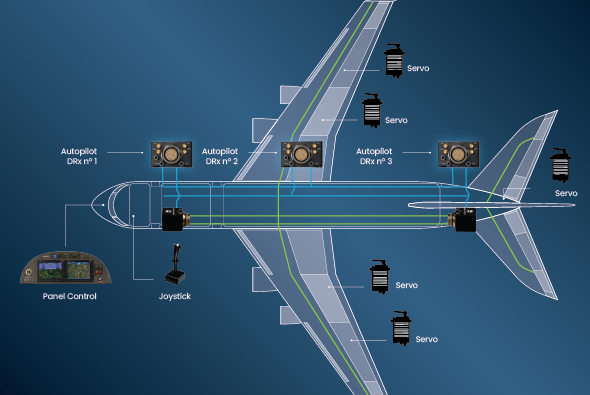
Veronte 1x, 4x and DRx provide different control arrangements. Comparing them against the same mission and failure requirements turns a catalogue choice into a defensible architecture decision.
Understand what is physically different
| Product | Documented arrangement | Main integration question |
|---|---|---|
| Veronte 1x | An individual configurable autopilot unit | What additional system measures are required for the intended operation? |
| Veronte 4x | Three internal autopilot cores, with an optional external fourth core | Which dependencies remain shared within and around the installation? |
| Veronte DRx | Distributed control hardware using three autopilot units in the reviewed manual | How will separation, interconnection and voting be implemented? |
The distinction is practical. An integrated assembly can simplify mounting and interconnection. Distributed hardware can support physical separation objectives, but adds installation locations, wiring and coordination requirements.
The DRx user manual describes connecting the three units for configuration and their network interconnection. Distribution is therefore an engineered system arrangement, not simply three independently purchased boxes placed around an aircraft.
Ask what must continue after a fault
A fail-safe requirement defines an acceptable response after a failure. A fail-operational requirement defines which functions must continue, for how long and under which specified failures. Write those functions explicitly before using either label in a purchase specification.
An illustrative requirement might demand continued control after loss of one computing element. Another might require a controlled recovery after loss of a navigation input. These are different problems, and neither is answered by the product name alone.
Assess detection, isolation, voting and the commanded response as part of the complete architecture. A fault that is detected but not managed appropriately can still defeat the intended outcome.
Find the common dependencies on a drawing
Trace power sources, converters, connectors, sensor feeds, buses and actuator supplies. Highlight anything relied on by all control paths. The exercise often exposes a limitation more quickly than a discussion of processor reliability.
For example, three controllers connected through a single vulnerable power-distribution element may share a loss-of-power failure. Separating the controllers physically does not remove that dependency. The same reasoning applies to a shared external sensor or actuator mechanism.
Manufacturer redundancy and development-assurance claims should be requested for the exact product baseline and interpreted with their assumptions. They are evidence for the aircraft programme, not automatic approval of the finished vehicle.
Compare complete proposals through Torquety
Use one requirement set to compare the candidate arrangements, including installation mass, wiring, configuration effort and required evidence. Confirm what is included in the proposed assembly and which peripherals or external elements are additional.
UK Supply & Technical Enquiries
Torquety represents Embention in the United Kingdom and imports, distributes and sells its avionics hardware. Send the aircraft layout, required failure responses, power architecture, sensors and actuator interfaces. Ask Torquety to compare Veronte control architectures for your project so the choice reflects the system you need to build and verify.